
5 ways Union Budget 2026 is Preparing India’s Workforce for 2047 & What It Means for MSMEs
- While India’s unemployment rate has fallen to 3.2%, nearly 30.6% of the working-age population lacks structured vocational training. The next phase of reform must therefore prioritise productivity and skill depth.
- Budget 2026 moves workforce policy from fragmented schemes to coordinated economic planning. The Education to Employment and Enterprise framework signals alignment between education systems and labour market demand, especially in the services sector.
- University townships near industrial corridors aim to reduce skill mismatches by embedding education inside live economic ecosystems, directly benefiting MSMEs located in these regions.
- Inclusion and access are being recognised as economic multipliers. District-level girls’ hostels and broader participation strategies expand the available workforce pool, strengthening long-term labour supply and enterprise stability.
- Future-readiness requires both applied skills and deep knowledge investment. From design education to telescope infrastructure, the Budget indicates that India’s 2047 workforce will require creativity, analytical strength, and innovation capacity alongside operational competence.
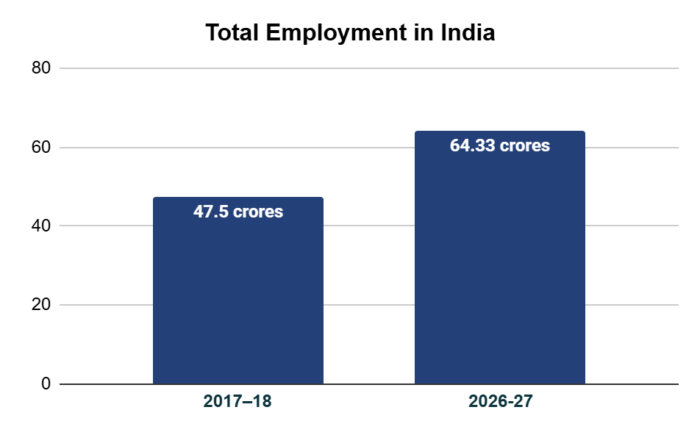
India’s total employment rose from 47.5 crore in 2017–18 to 64.33 crore in 2023–24, reflecting an increase of 16.83 crore jobs over six years. Despite being one of the largest talent pools in the world, the depth of formal skill preparation remains limited. For instance, only 4.1% of individuals aged 15–59 years have received formal vocational or technical training, while 30.6% depend on informal learning pathways. This means that 65.3% of the working-age population lacks any structured vocational or technical training.
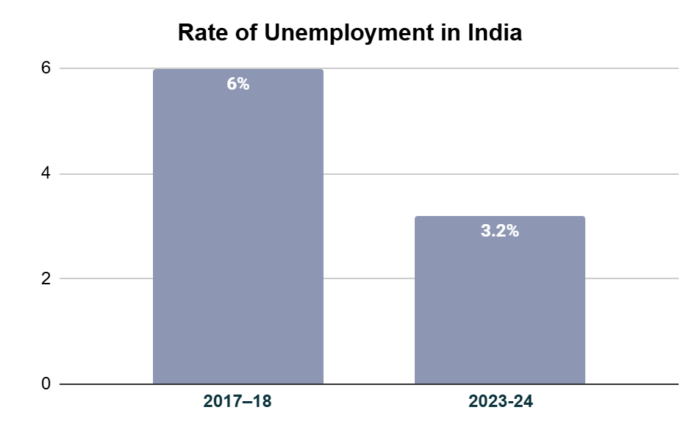
While India’s unemployment rate on usual status has declined from 6.0% in 2017–18 to 3.2% in 2023–24, the challenge is no longer only about job availability, but about job quality, productivity, and workforce readiness. A workforce that relies on informal skill acquisition often faces low wages, income volatility, unsafe working conditions, and limited access to social security. As productivity remains uneven, skill mismatches persist, and global competitiveness suffers.
This is the context in which the Union Budget 2026–27 signals a move away from fragmented skilling schemes toward building a long-term workforce architecture that aligns education, employment, enterprise, and economic geography.
This blog article looks at 5 ways Budget 2026 is preparing India’s workforce for 2047.
- Education As a Path to Employment and Enterprise
One of the most structural proposals in the Budget is the creation of a high-powered Education to Employment and Enterprise Standing Committee, with a focus on the services sector. India’s services sector already contributes more than half of the country’s economic output and employs a significant share of the workforce. Future job growth is expected to be concentrated in services, including logistics, digital services, financial intermediation, healthcare, design, and professional support.
However, the transition from education to employment remains inconsistent. Academic qualifications do not always translate into job-ready skills. The proposed Standing Committee attempts to close this gap by formally linking educational planning with labour market demand and enterprise creation. This marks a shift in thinking. Workforce readiness is no longer treated as a social welfare agenda. It is being positioned as economic planning.
What it Means for MSMEs
For MSMEs, this alignment reduces the burden of correcting foundational skill gaps during hiring. It creates a clearer pipeline from classroom to shopfloor to enterprise.
- Embedding Learning Ecosystems Inside Industrial Growth Corridors
The Budget proposes establishing 5 university townships near major industrial and logistics corridors. India’s industrial corridors, whether manufacturing clusters, logistics hubs, or emerging services centres, are engines of regional employment. By locating higher education ecosystems within these corridors, the Budget aims to integrate learning with live economic activity.
Students gain exposure to industry processes, supply chains, warehousing systems, service operations, and digital logistics platforms during their education. Apprenticeships and internships become more accessible. Industry feedback can influence curriculum design in real time.
What it Means for MSMEs
For small manufacturers, transport operators, warehousing businesses, and service providers located along these corridors, this creates access to a nearby, industry-aware talent pool. It reduces hiring friction and lowers the time required to make new employees productive. Over time, this reduces skill-location mismatches — a persistent issue in India’s labour market.
- Expanding Design and Creative Skills for a Services-Led Economy
The announcement of a new National Institute of Design in the eastern region, through a challenge route, signals another important shift. In a services-led and digitally connected economy, design influences product development, user experience, branding, packaging, digital interfaces, and value differentiation.
By expanding access to formal design education beyond traditional urban clusters, the Budget widens the geographic distribution of creative talent. This strengthens regional enterprise ecosystems and allows businesses outside metros to tap into design-led value addition. In the long term, creative skills become as economically important as technical ones.
What it Means for MSMEs
For MSMEs, especially in manufacturing, handicrafts, food processing, consumer goods, and digital services, design capability directly impacts competitiveness. Better product aesthetics, improved packaging, efficient user interfaces, and stronger branding can significantly enhance market reach.
- Widening Workforce Participation by Removing Structural Barriers
Workforce readiness is not just about access but also training content. The Budget proposes establishing one girls’ hostel in every district through capital support or viability gap funding. This measure addresses one of the less discussed barriers to workforce participation: safe, accessible accommodation for women pursuing higher education or training. Female labour force participation in India has historically lagged behind that of men. Improving access to education and training for women directly expands the available talent pool.
What it Means for MSMEs
Higher participation also improves household incomes, enhances financial inclusion, and strengthens local economic ecosystems. For MSMEs, especially in services, retail, healthcare, education support, and light manufacturing, a broader female workforce increases hiring flexibility and operational stability. Inclusion, therefore, becomes a growth strategy, instead of being limited to social commitment.
- Investing in Long-Horizon Science and Knowledge Talent
Preparing India’s workforce for 2047 requires investment beyond immediate employability. It requires nurturing knowledge ecosystems that create innovators, researchers, and high-skill professionals who can compete globally. Scientific depth strengthens the upper layers of the workforce pyramid — which, in turn, drives innovation-led growth across sectors.
The Budget’s plan to set up or upgrade four telescope infrastructure facilities to promote astrophysics and astronomy may appear specialised. However, it signals long-term thinking. Advanced scientific infrastructure builds analytical capacity, quantitative reasoning, and research orientation. These are foundational capabilities for future industries, including space technology, advanced materials, data science, satellite services, and high-precision manufacturing.
What it Means for MSMEs
Scientific and research-led education improves the overall quality of the talent pool. As analytical and problem-solving skills strengthen, MSMEs gain employees who can manage complex production systems, quality processes, and digital tools more effectively.
In sectors such as precision manufacturing, electronics, engineering components, and data services, access to scientifically trained talent supports innovation. Even traditional industries benefit when supervisors and technicians have stronger quantitative and analytical skills.
Enabling MSMEs to Build Future-Ready Workforces
For India’s MSMEs, workforce reform has direct implications. The dominance of informal training means MSMEs often bear the hidden cost of skill correction. Time spent retraining new hires reduces productivity and increases operational risk. By aligning education with enterprise demand, embedding institutions within industrial corridors, expanding formal design capabilities, and widening participation, the Budget helps reduce this burden.
Better-prepared workers improve productivity. Design-aware employees enhance product value. Increased female participation strengthens labour supply. Proximity to educational hubs improves hiring efficiency.
Over time, these structural measures support higher operational efficiency, improved compliance with quality and safety standards, greater ability to adopt digital tools, and stronger resilience in competitive markets. For MSMEs in Tier-2 and Tier-3 cities, this is particularly significant. Workforce reform allows smaller enterprises to scale without disproportionate investment in in-house training infrastructure.
Source:
- Ministry of Labour and Employment, October 2025
- The 13th India Skill Report (December 2025)
- The 13th India Skill Report (December 2025)