
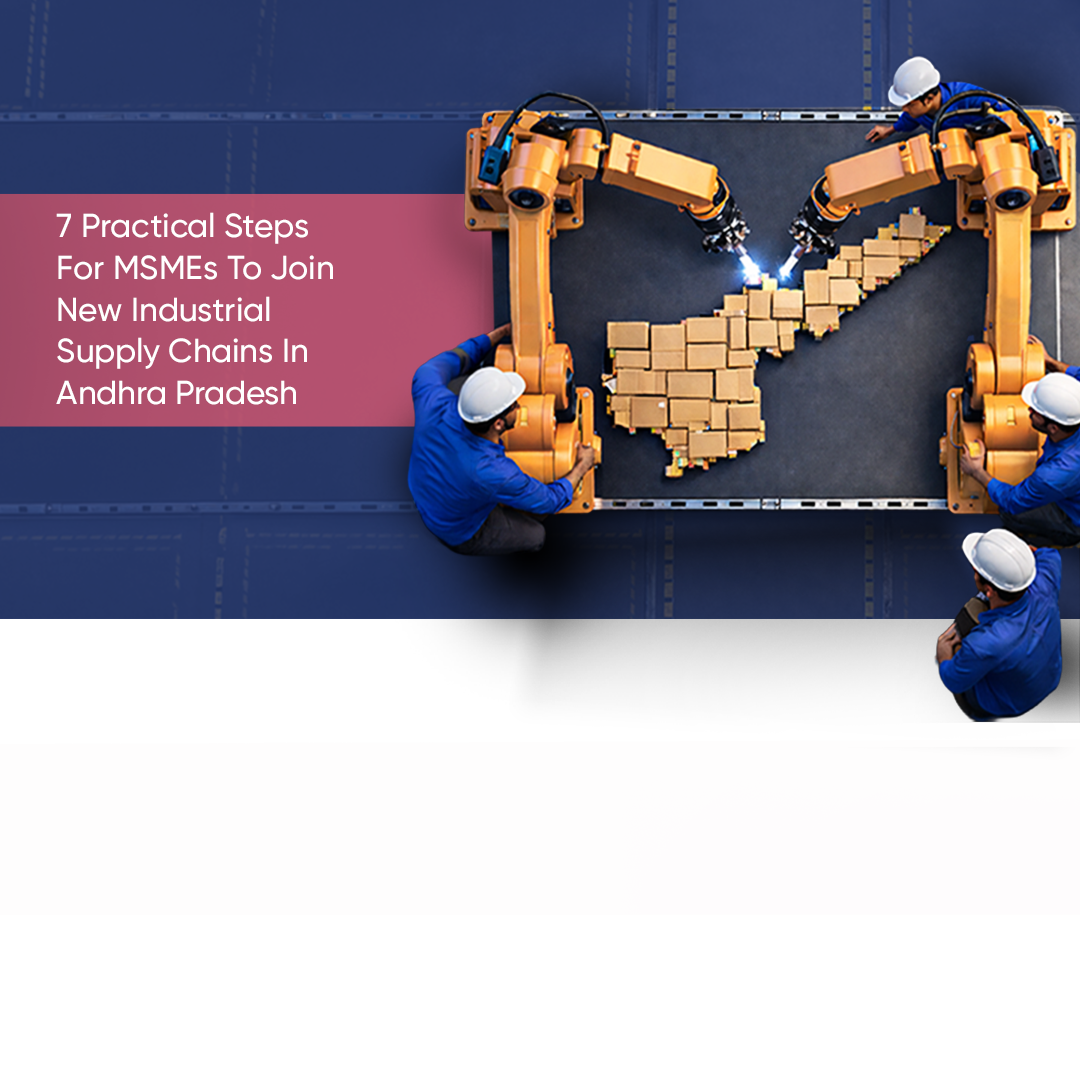
7 Practical Steps for MSMEs to Join New Industrial Supply Chains in Andhra Pradesh
According to recent news articles, a new battery gigafactory worth ₹8,175 crore will be set up in Andhra Pradesh, expected to cover the full value chain, generate around 3,000 direct jobs, and strengthen domestic clean energy manufacturing.
The project opens the door for MSMEs in fabrication units, electrical suppliers, packaging businesses, maintenance contractors, machine shops, and logistics operators to support regular production needs.
As large manufacturers expect consistent quality, proper documentation, delivery discipline, and compliance standards, small businesses need stronger systems before they can become reliable vendors.
Finance often becomes the deciding factor in whether a supplier can actually grow with such opportunities. MSMEs may need funds for machinery, tooling, raw material stocking, hiring, and working capital during the ramp-up period.
Andhra Pradesh has showcased its manufacturing prowess recently for several reasons, and one such example is the announcement of a new battery gigafactory in the state. The project involves an investment of ₹8,175 crore and has an integrated setup covering cell manufacturing, battery packs, and large-scale battery energy storage systems. It is expected to generate around 3,000 direct jobs and benefit several local small manufacturers and service providers
Why is Andhra Pradesh gaining interest among large corporates
Andhra Pradesh is becoming relevant for large manufacturers, as location choice depends on how efficiently a project can be built, supplied, and scaled over time. The state offers a mix of industrial infrastructure, logistics access, and policy support that suits large manufacturing investments.
The state’s industrial corridors and parks improve the possibility of supplier clustering, while port connectivity supports the movement of raw materials and finished goods. Road and logistics networks also strengthen turnaround efficiency, which becomes especially important for sectors that depend on timely procurement and dispatch.
The state’s policy direction adds to this advantage. Under the Integrated Clean Energy Policy, Andhra Pradesh is positioning itself to attract investment across clean energy, storage, and related manufacturing ecosystems. The state has also approved 27 additional projects worth ₹29,021 crore, while emphasising that “Speed of Doing Business” should guide industrial approvals1. For manufacturers, this creates confidence that project execution can move with greater momentum. For MSMEs, it signals that supplier opportunities are more likely to emerge in locations where large investments are backed by infrastructure and faster approvals.
How Mega-Factories Create Opportunities for MSME Supply Chains
A large manufacturing plant depends on many supporting layers, often built by smaller businesses in the following ways:
Components and sub-assemblies
Industrial plants need fabricated structures, racks, brackets, frames, fasteners, enclosures, and precision metal parts. They also need cable harnesses, connectors, electrical panels, junction boxes, and industrial wiring support. Many of these are realistic product segments for MSMEs that already work in fabrication, machining, or electrical assembly.
Packaging and movement
Any factory operating at scale needs pallets, corrugated packaging, protective packaging, labelling solutions, and transport-ready packing systems that meet industrial compliance standards. These are not small side requirements. They are part of daily operations.
Support services
Tooling, dies, machine maintenance, calibration, testing assistance, plant housekeeping, industrial consumables, and technical servicing often create recurring demand. These segments can be especially relevant for MSMEs that may not begin as component makers but can still enter the ecosystem through operational support.
This is how the anchor factory effect works. One major plant starts drawing in smaller suppliers because regular production creates regular demand. Over time, this can help build a broader local vendor base and reduce the need to source every small requirement from faraway industrial centres.
How MSME Supplier Expectations Change in Large Manufacturing Ecosystems
While MSMEs have a significant opportunity, they must not assume that demand automatically translates into industrial orders. In reality, the requirements change sharply when the buyer is a large manufacturer.
As quality consistency and proper documentation become more crucial, delivery timelines become tighter, and missed schedules can affect future business. Traceability, inspection, compliance records, and process discipline begin to matter much more than they do in many informal or semi-formal markets.
A Practical Readiness Checklist for MSMEs
Before entering a megafactory-linked supply chain, MSMEs need to evaluate whether they are ready in terms of their business, processes, and finances. Here’s how they can do that:
- Define the supply opportunity clearly
Before entering a gigafactory-linked supply chain, MSMEs need to evaluate themselves if. the scope can be fulfilled and this should be supported by a realistic cost sheet, an understanding of margin, and an estimate of whether existing capacity can handle repeat orders.
- Strengthen operational and quality systems
Large manufacturers usually expect stronger process standardisation, regular quality checks, proper testing logs, better inventory control, and cleaner production planning. For many MSMEs, the biggest challenge is not product capability alone, but becoming system-ready for industrial buyers.
- Keep vendor onboarding documents ready
GST details, Udyam registration, bank statements, past order records, and basic compliance documents are often required before any serious supplier discussion moves forward. Many businesses lose momentum at this stage because documentation is incomplete or poorly organised.
- Improve process documentation and delivery discipline
Inspection methods, production logs, delivery records, and testing practices need to be structured and easy to present. This helps build credibility during onboarding and ensures smoother long-term supplier relationships.
- Plan financial readiness in advance
MSMEs should map inventory days, receivable days, and payment cycles before committing to expansion. Working capital needs should be separated from capital expenditure needs, and a buffer should be created for the first few months of scale-up, when expenses often rise faster than collections.
- Approach expansion in a structured way
Careful preparation helps MSMEs scale sustainably. Businesses that plan operational systems, documentation, and financing together are more likely to grow without putting pressure on day-to-day operations.
- Maintain a healthy CIBIL score and credit profile
A strong CIBIL score is important not only when applying for working capital support, but also when financial discipline is evaluated as part of supplier readiness. A robust credit profile also improves the ability to respond quickly to urgent orders and build long-term buyer relationships.
The Role of Finance in MSME Supply-Chain Expansion
Even when demand is visible, supplier growth requires businesses to invest before additional revenue begins to flow in. New machines may be needed to increase output. Tooling and fixtures may need to be upgraded. Raw material stocking may have to rise to support larger orders. Businesses may also need to hire or upskill workers while improving quality systems and shop-floor processes to meet stricter buyer expectations. Together, these requirements can put immediate pressure on cash flow.
Working capital becomes especially important at this stage. Large manufacturers often operate with receivable cycles of 30 to 90 days, but day-to-day business costs begin much earlier. Wages, electricity, transport, material purchases, and routine operating expenses continue without delay. As a result, an MSME can experience higher activity levels without the same liquidity comfort during the expansion phase.
This is why many MSMEs struggle even when the business opportunity is strong. The challenge is often not the lack of orders, but the gap between production readiness and financial readiness. If this gap is not carefully planned for, a growing business can face pressure from both sides: delayed collections on the one hand and rising operating costs on the other.
In this context, structured financing becomes an important enabler of sustainable growth.
How Structured Financing Helps
Structured financing becomes important because supplier expansion often requires businesses to invest ahead of cash inflows. Machinery may need to be added, tooling may need to be upgraded, and working capital may need to cover higher raw material stocking, wages, and operating costs during receivable cycles. In such situations, it’s crucial for MSMEs to have lenders who understand business expansion in practical terms. With a strong physical presence in South, including 6 branches in Andhra Pradesh, RBI-regulated NBFCs such as Protium can provide relevant support. With offerings such as Loan Against Property, Business Loan, and Machinery & Equipment Finance, such institutions can help MSMEs plan expansion more steadily while managing both asset creation and day-to-day business funding needs.