

7 Reasons Service MSMEs Could Play a Bigger Role in India’s Next Growth Phase
- As India’s service sector emerges as one of the economy’s main growth engines, service MSMEs are becoming increasingly important. They provide essential support across logistics, repair and maintenance, professional services, hospitality, healthcare, education, technology, warehousing and business support.
- This blog article identifies 7 opportunity areas for service MSMEs, including manufacturing support, Tier-2 and Tier-3 demand, digital expansion, exports and specialised B2B services, along with practical steps to capture them.
Service MSMEs form an important part of India’s expanding services sector, which has emerged as one of the economy’s main growth engines. Small businesses operate across logistics, repair and maintenance, professional services, hospitality, healthcare, education, information technology, warehousing and business support. As India’s manufacturing, trade and consumer markets grow, these businesses could play a much larger role in supporting the country’s next phase of economic growth.
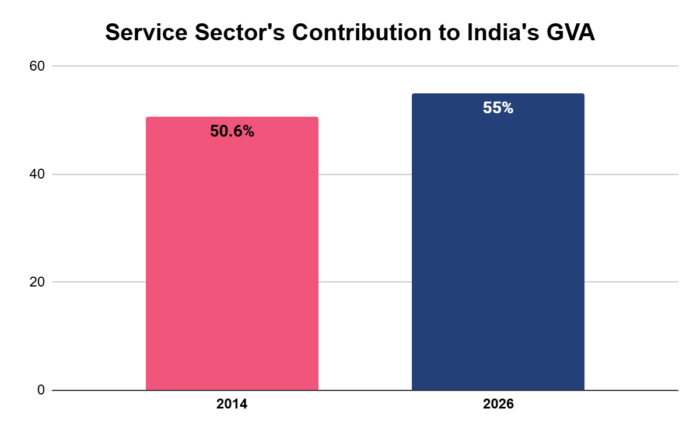
Their growing relevance is closely linked to the strength of the wider services economy. The sector’s contribution to the country’s Gross Value Added has increased from 50.6% in FY14 to around 55% in 2026, while it has recorded an average growth of 8.3% since FY23. Services have also consistently attracted the highest share of foreign direct investment, reflecting their importance to India’s economic expansion. Alongside its contribution to growth, the sector supports employment across a wide range of activities and regions, currently employing 18.2 crore individuals.
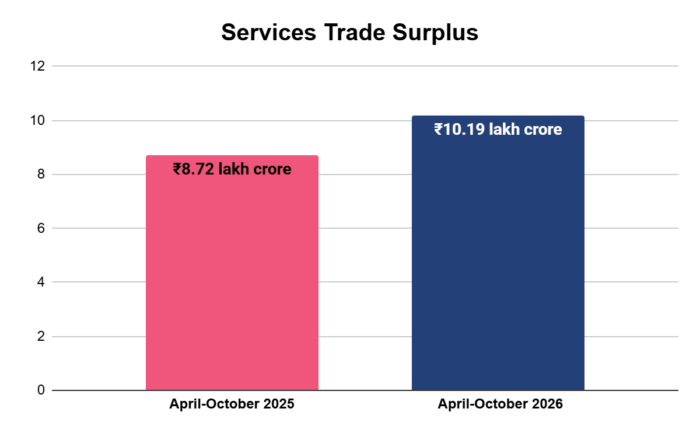
The sector’s growth momentum has remained strong in FY26. Between April and October 2025, services exports reached approximately ₹20.40 lakh crore, while imports stood at ₹10.21 lakh crore. This resulted in a services trade surplus of around ₹10.19 lakh crore, compared with ₹8.72 lakh crore during the same period in FY25. Strong export demand and increased hiring further supported the sector’s performance1.
Service MSMEs are especially relevant as India’s economic momentum showed signs of moderation during April and May 20262. Agriculture is also facing weather-related risks, including the possibility of a strong El Niño, below-average rainfall and lower reservoir levels. Against this background, services are expected to play a critical role in sustaining economic growth during the second half of 2026. While these sectors remain closely connected, services can provide additional support to the economy when growth in other areas becomes uneven.
As domestic consumption, business activity, digital adoption and regional markets expand, service MSMEs have an opportunity to strengthen their role within this growing ecosystem. The following 7 areas show where demand could emerge and how businesses can prepare to capture it.
1. Services Could Help Sustain Growth as Other Sectors Face Headwinds
Service businesses are connected to almost every part of the economy. Companies continue to require transport, accounting, repairs, technology, compliance and other support even when business conditions become difficult.
Demand may change, but many essential services cannot be stopped completely. A manufacturer may postpone the purchase of new machinery but continue to spend on maintaining its existing equipment. A trader may reduce inventory but will still require billing, transport and payment services. A hotel may control expansion costs but continue to depend on housekeeping, food supplies and maintenance.
This gives several service activities a degree of stability. The Economic Survey has described services as an important anchor for growth because the sector has generally shown less fluctuation than agriculture and industry.
How service MSMEs can capture it
Service MSMEs should identify the parts of their business that generate regular and repeat demand. These could include annual maintenance, monthly accounting, software support, vehicle servicing or ongoing logistics contracts.
Instead of expanding into several unrelated areas, businesses can strengthen their most dependable services. Clear processes, trained employees and reliable response times can help them manage more customers without affecting quality.
Capacity should be expanded gradually. New staff, equipment or locations should be added only when there is enough demand to support the additional cost.
2. Manufacturing Growth Creates More Demand for Business Services
Manufacturing does not operate in isolation. Every factory depends on a network of supporting service providers. These include transporters, warehouses, machinery repair firms, laboratories, technology companies, packaging providers, accountants and compliance consultants.
When a manufacturer increases production, adds machinery or enters a new distribution area, the requirement for such services also grows. Even a small factory may depend on several external partners to keep production running and deliver finished products to customers.
This creates opportunities for service MSMEs that may not manufacture anything themselves but help manufacturers operate more efficiently.
How service MSMEs can capture it
Service MSMEs can begin by studying the requirements of factories and industrial clusters in their region. A machinery repair business can specialise in equipment commonly used by local manufacturers. A transporter can develop fixed routes between industrial areas and nearby markets. A software provider can create billing or inventory systems suited to small factories.
Businesses should also improve their vendor documentation. Larger manufacturers generally expect proper registrations, invoices, quotations, contracts and service records.
Specialisation can help a service MSME stand out. A business that clearly understands one type of equipment, process or industry may be more useful to a manufacturer than a general service provider offering several unrelated solutions.
3. Trade and Transport Can Create New Opportunities
Domestic trade depends on the movement of goods between factories, warehouses, wholesalers, retailers and customers. As distribution networks grow, businesses require transportation, storage, inventory management, packaging and last-mile delivery.
Trade and transport are among the service segments that could support growth in 2026, with lower crude oil prices reducing operating costs for the segment.
The opportunity is not limited to national logistics companies. Regional transporters and warehouse operators can serve routes and locations that larger businesses may not cover efficiently.
How service MSMEs can capture it
Transport and logistics MSMEs can improve delivery planning, monitor fuel expenses and maintain their vehicles regularly. Route-planning tools can help reduce unnecessary travel and empty return trips.
Businesses can also form partnerships with local manufacturers, wholesalers, retailers and online sellers. A reliable delivery network covering nearby towns can become a strong advantage.
However, expansion should be planned carefully. Adding vehicles or warehouse space without confirmed business can increase fixed costs. Before investing, MSMEs should assess expected order volumes, payment timelines, maintenance expenses and working capital requirements.
4. Tier-2 and Tier-3 Growth Is Expanding Local Service Demand
Business activity is gradually spreading beyond India’s largest cities. Industrial areas, housing projects, hospitals, educational institutions, hotels and retail centres are creating new service requirements in Tier-2 and Tier-3 markets.
Growing businesses in these locations require accountants, transporters, repair technicians, technology providers, marketing agencies, trainers and consultants. Consumers also require healthcare, education, hospitality and personal services.
Local service MSMEs may have an advantage because they understand regional languages, customer expectations, payment practices and local business conditions. They may also be able to respond faster than a service provider located in a distant metro city.
How service MSMEs can capture it
Local businesses can begin by mapping the unmet needs within their district. Customer complaints, delayed services and limited supplier options can indicate where an opportunity exists.
Expansion into neighbouring districts does not always require an immediate investment in a new branch. Businesses can first use travelling service teams, local partners or digital communication to test the market.
Industry associations, trade groups and local business events can also help MSMEs meet potential customers and understand sector-specific requirements.
Once demand becomes regular, a business can consider hiring local employees, purchasing additional equipment or setting up a permanent service centre.
5. Digital Adoption Is Making It Easier for Service Businesses to Scale
Many services are no longer restricted to one location. Accounting, design, consulting, training, marketing, customer support and certain technology services can be delivered partly or completely through digital platforms.
Digital tools can also improve services that require physical delivery. A repair business can schedule appointments online. A logistics company can track vehicles. A hotel can manage bookings. A professional firm can share documents and updates with clients.
India’s strength in digitally deliverable services has supported the expansion of the sector within the country and in international markets.
How service MSMEs can capture it
MSMEs can start with simple tools that solve an immediate business problem. Digital billing can reduce paperwork. Online payments can improve collections. Customer-management tools can organise enquiries and follow-ups. Cloud-based records can help employees access updated information.
A clear online presence can also help. A verified business listing, basic website or professional social media page can make it easier for customers to understand the services offered.
Technology should support operations rather than create unnecessary costs. Businesses should choose tools based on actual requirements, train employees to use them and maintain suitable data-security practices.
6. India’s Strength in Services Can Open Export and Supply Chain Opportunities
India has established capabilities in software, professional services, consulting, engineering and business support. Services exports have also become an important part of the country’s external sector.
According to the Economic Survey 2025–26, services exports provided an important buffer during a period of weaker global goods trade. Software services accounted for more than 40% of total services exports, while professional and management consulting also recorded strong growth.
Smaller firms can participate in this opportunity without immediately opening offices outside India. They can provide specialised services to Indian exporters, larger technology companies and other firms serving overseas clients.
How service MSMEs can capture it
Businesses should identify a specific capability in which they can develop expertise. This could include engineering design, software testing, digital marketing, bookkeeping, research support or customer service.
Serving international clients or larger exporters requires consistent quality, clear communication, data security and proper documentation. Some industries may also require certifications or formal quality systems.
Service MSMEs can begin with smaller projects and build a record of completed assignments. Strong references and dependable delivery can then help them compete for larger contracts.
7. Growing Businesses Need More Specialised External Partners
As companies grow, it becomes difficult to manage every business function internally. Many companies therefore depend on outside experts for technology, compliance, recruitment, employee training, machinery maintenance, marketing, logistics and customer service.
This creates opportunities for service MSMEs that understand a particular problem and can solve it consistently. Many of these services are also required regularly rather than as a one-time purchase. This can help service providers build longer-term customer relationships and more predictable revenue.
How service MSMEs can capture it
Specialisation should be supported by skilled employees and clear service standards. Businesses should prepare proper proposals, pricing terms, timelines and work agreements.
Formal documentation is equally important. Invoices, contracts, work records and customer feedback can make it easier to work with larger clients.
Before accepting a major assignment, service MSMEs should check whether they have sufficient employees, technology, equipment and working capital. A large contract can create pressure when payments are received only after the work has been completed.
Formal business finance can support expansion when it is linked to a clear requirement, such as hiring employees, purchasing equipment, adopting technology or managing the payment period of a confirmed contract.
The larger opportunity is for service MSMEs to become more than small local providers. With the right skills, systems and capacity, they can become dependable partners to manufacturers, traders, larger companies and customers across wider markets.
—
1 IBEF, Services Industry Report, Feb, 2026
2 HSBC Global Investment Research, July 2026