

8 Actionable Steps for MSMEs to Prepare for FTA-Led Healthcare Opportunities
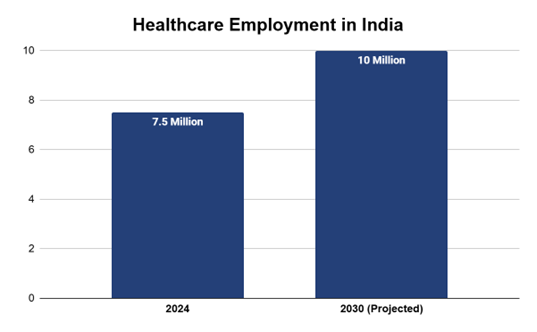
- India’s healthcare sector employs 7.5 million people, with AI integration expected to create nearly 3 million more jobs by 2028. The country is also the world’s third-largest pharmaceutical producer, with annual exports exceeding $25 billion. These numbers mean healthcare is expanding not only as a domestic service sector, but also as an export opportunity.
- As the opportunity widens beyond hospitals and large pharmaceutical companies, MSMEs in devices, packaging, diagnostics, wellness, and support services can benefit from the export prowess.
- FTAs can help healthcare MSMEs in this sector by lowering trade barriers, improving regulatory access, and facilitating stronger entry into international value chains. But MSMEs must prepare early, focusing on compliance, quality standards, and export readiness to benefit the most.
- From improving documentation to tracking which FTAs apply to which product categories, this blog outlines practical steps MSMEs can take to become better prepared for FTA-led healthcare opportunities.
As of FY2024, India’s healthcare sector employed 7.5 million people, and AI-led transformation is expected to add nearly 3 million more jobs by 2028.1 The country is also the world’s third-largest pharmaceutical producer by volume, with annual exports exceeding $25 billion. It meets around 50% of Africa’s generic medicine demand, 40% of the US demand for generics, and 60–70% of the WHO’s vaccine requirement2. India’s key pharmaceutical exports include formulations, biologics, and APIs, with major markets such as the US, the UK, South Africa, and Russia. This means that healthcare demand in India is no longer limited to hospitals. A growing system creates requirements at many levels. Medical consumables, device components, sterile packaging, sample transport systems, labeling, diagnostic support products, wellness formulations, telemedicine support, cold-chain logistics, facility management, and back-end digital solutions all become part of the same growth story.
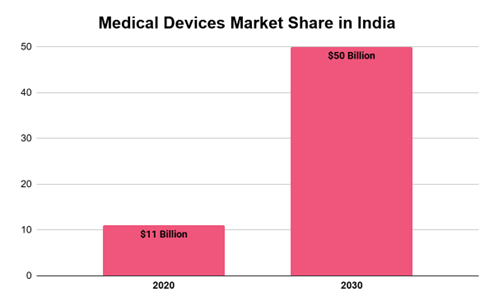
For instance, India’s National Medical Devices Policy projects the sector to grow from about $11 billion in 2020 to $50 billion by 20303. Also, the digital health market alone is projected to reach US$ 47.8 billion by 2033, underscoring how quickly healthcare is becoming linked to technology, process design, and service delivery. And MSMEs play a crucial part here because growth in one part of healthcare usually creates demand in several adjacent categories where smaller businesses can compete effectively.
Government’s Healthcare Hub Vision is Opening New Export Pathways
The Union Budget 2026–27 proposed support for five Regional Medical Hubs to promote India as a hub for medical tourism services. These hubs are meant to function as integrated healthcare complexes with medical, educational, and research facilities, along with AYUSH centres and medical value tourism facilitation infrastructure. This matters because healthcare exports are not limited to sending products abroad. They also include services, specialised treatment, patient support, rehabilitation, wellness offerings, and all the supply chains behind them.
For MSMEs, that creates practical openings. A stronger medical tourism ecosystem can increase demand for quality-certified vendors, specialised packaging, patient-care consumables, translation and facilitation services, diagnostics-linked supplies, nutraceuticals, wellness products, and local healthcare infrastructure support. In other words, the healthcare hub vision is not just about large hospitals attracting international patients. It is also about the wider vendor base that makes such a system work consistently and at scale.
FTAs Enhancing Opportunities for Healthcare MSMEs
India’s recent FTA messaging has made it clear that healthcare, pharmaceuticals, and MedTech are among the sectors expected to benefit from improved trade access. This is because FTAs lower or remove import duties in partner markets, reduce duplication in regulatory processes, and create more predictable business conditions for exporters. These factors impact MSMEs because smaller businesses are usually more sensitive to delays, cost uncertainty, and documentation friction.
One of the examples is the India-New Zealand FTA. The official announcement noted faster regulatory access for pharmaceuticals and medical devices through acceptance of inspection reports from comparable regulators. That kind of provision can reduce repetitive compliance burdens, lower costs, and shorten approval timelines. For a smaller exporter, this is not a technical detail. It directly affects the ability to price competitively, plan shipments, and respond to buyer demand without excessive delay.
Which Healthcare-Linked MSMEs can Benefit the Most
The most important point for MSMEs is that the healthcare export opportunity is broader than finished medicines. Pharmaceutical support MSMEs can benefit through packaging, labeling, quality testing support, API-linked services, and process inputs. Medical device and component makers can benefit through tubing, plastics, disposables, sterilization inputs, sensors, and precision parts. Diagnostics-linked MSMEs can play a role in test support products, lab fixtures, consumables, and sample handling systems. Wellness and AYUSH-linked businesses can find room in herbal products, therapy support products, and nutraceutical packaging. Service MSMEs can participate through health-tech support, telemedicine operations, medical travel assistance, and healthcare facility services.
The range of businesses that can participate in this opportunity is wide, but for many MSMEs, the real challenge is whether they are prepared to operate within the ecosystem. Demand may be growing, and FTAs may improve access to overseas markets, but these advantages do not automatically translate into export readiness. MSMEs need a clear operational roadmap.
Eight Ways MSMEs can Get Ready for the FTA-Led Opportunities
Businesses that want to benefit from FTA-led healthcare opportunities need to move beyond broad sector interest and assess what operational changes are required to become credible suppliers in domestic and global healthcare value chains. The following eight steps provide a useful starting point for MSMEs that want to prepare more systematically.
1. Identify the Exact Healthcare Segment the Business Serves
Preparation starts with clarity. MSMEs should define whether they belong to pharma support, medical devices, diagnostics, wellness, digital health, logistics, or healthcare services. Without that clarity, export planning stays vague and product positioning becomes weak.
2. Improve Product Documentation
Product specifications, input details, process notes, batch records, usage instructions, and supplier documentation must be organised and updated. In export markets, weak documentation creates distrust faster than weak marketing.
3. Align with quality and Testing Requirements Early
Healthcare buyers usually expect more than basic product readiness. They expect process discipline, test records, quality checks, and traceability. MSMEs that build these systems early are in a stronger position when larger buyers or export partners begin screening vendors. Quality-led growth has also been emphasized by the government in the context of FTA opportunities.
4. Strengthen Packaging and Labeling Compliance
In healthcare, packaging is not only about appearance. It affects safety, storage, transport, regulatory acceptance, and buyer confidence. MSMEs should review labeling formats, product information, material suitability, and shipping durability before approaching export markets.
5. Prepare Export-Ready Pricing and Costing
Many businesses calculate pricing only for domestic sales. Export readiness requires a wider costing view that includes compliance, packaging upgrades, logistics, duties where relevant, distributor margins, and possible delays. A realistic pricing structure helps avoid unviable export orders.
6. Build Small but Reliable Production Capacity
Not every MSME needs a massive factory upgrade. What matters first is consistency. Buyers generally prefer a smaller supplier that can deliver predictable quality on time over a larger supplier with unstable execution. For healthcare-linked exports, reliability often matters more than scale in the early stages.
7. Match Relevant FTAs to Product Categories
This is one of the most practical and most neglected steps. MSMEs should not treat FTAs as a general policy announcement. They need to understand which agreement applies to which product line, what tariff benefit exists, what standards may be recognised, and what documentation is required to claim the benefit. That is how a trade agreement becomes commercially useful instead of remaining a policy announcement.
8. Build a Support Network Around Compliance and Certification
Healthcare exports involve more moving parts than many domestic sales. MSMEs benefit when they build a support network around compliance, certification, trade information, and financing. They must work with export councils, clusters, and formal lenders. This is also where financial planning becomes important. Businesses need funds for machinery upgrades, better packaging, working capital, or quality-related investments before export revenue begins to come in. They can reach out to RBI-regulated NBFC such as Protium for structured financing through Loan Against Property, Machinery & Equipment Finance, and Business Loan for various needs in cleaner production processes, upgraded testing systems, or additional working capital to meet larger orders.
India’s healthcare expansion is creating a larger and more varied commercial ecosystem than before. The businesses that benefit most will be the ones that prepare early. FTA-led healthcare growth can open the door to a larger and more resilient export future.