

9 Ways Exports Are Emerging as a Key Growth Engine Under Union Budget 2026–27
- Union Budget 2026–27 signals a structural shift in economic thinking. Instead of treating exports as a result of domestic expansion, the Budget positions them as the engine powering it.
- From semiconductors and electronics to textiles and cluster modernisation, the Budget strengthens domestic production capacity across both high-value and labour-intensive sectors.
- Infrastructure investments in freight corridors, waterways, logistics parks, and SEZ reforms reduce transit time and logistics costs. At the same time, automated customs, electronic sealing, longer validity of advance rulings, and removal of export caps lower transaction friction.
- Exports are increasingly diversified beyond goods. IT, digital services, cloud infrastructure, analytics, and AVGC are positioned as parallel growth engines. Policy clarity, tax certainty, and long-term incentives for digital infrastructure support services-led expansion.
- With the ₹10,000 crore SME Growth Fund, enhanced credit guarantees, mandatory TReDS usage, and improved payment discipline, the Budget addresses the financial bottlenecks that often constrain export-oriented MSMEs.
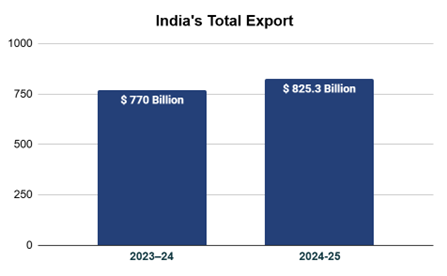
India’s total exports reached $825.3 billion in FY 2024-25, up from $770 billion in FY 2023–24, with a 6% YoY growth. Services exports alone exceeded $325 billion, reflecting strong performance in IT, business services, and digital segments.1 Amid this resilient environment, the Union Budget 2026–27 outlines a strategy that places exports at the centre of economic expansion; manufacturing scale, services leadership, logistics modernisation, and credit access as interconnected pillars. Exports are also positioned as a structural driver of employment, industrial deepening, and global value chain participation.
This marks a clear shift from short-term export incentives toward building long-term export capacity across sectors, regions, and firm sizes, especially MSMEs operating in tier-2 and tier-3 cities. The strategic shift is not reflected in a single scheme or allocation. Instead, it unfolds across multiple policy layers that collectively strengthen India’s export engine. The following measures show how the Budget is building export capacity in practice.
- Manufacturing-Led Export Growth Across Strategic and Labour-Intensive Sectors
The first pillar of the export engine is manufacturing expansion. The Budget strengthens the link between production scale and export competitiveness by deepening domestic value addition and reducing critical import dependence.
Strategic sectors such as semiconductors, biopharma, electronics, chemicals, rare earth processing, and capital goods receive targeted policy and investment support. Strengthening these industries enables India to move into higher segments of global value chains, where margins and technology intensity are stronger. As production depth improves, export reliability and cost efficiency improve alongside it.
At the same time, labour-intensive industries remain central. Textiles, footwear, sports goods, handicrafts, and handlooms are prioritised through cluster-based development, technology upgrades, and skilling. These sectors generate employment at scale and are deeply rooted in regional manufacturing ecosystems. Strengthening them ensures that export growth translates into broad-based job creation.
The revival of up to 200 legacy industrial clusters further addresses productivity gaps. Infrastructure upgrades, improved machinery, shared testing facilities, and compliance support reduce rejection rates in international markets. Higher productivity strengthens price realisation, reinforcing exports as a sustained growth driver.
2. Electronics, Semiconductors and High-Value Manufacturing as Export Multipliers
As global trade shifts toward technology-intensive products, high-value manufacturing becomes critical to export-led growth. The Budget recognises that long-term export expansion requires deeper upstream and midstream capabilities.
India Semiconductor Mission 2.0 aims to strengthen fabrication, assembly, and design capabilities, positioning India as both a manufacturing and technology hub. Expanding electronics components manufacturing reduces reliance on imported inputs, strengthening domestic supply chains and improving delivery predictability.
The development of rare earth corridors and chemical parks supports advanced manufacturing exports in electronics, renewable energy components, and specialty chemicals. These initiatives shift export growth toward higher-value segments rather than volume-driven expansion alone.
Support for container manufacturing further enhances export resilience by reducing freight dependency during global disruptions. Together, these measures strengthen the structural foundation of high-value exports.
3. Textiles, Footwear and Traditional Industries Receive Renewed Export Focus
While strategic sectors expand upward, traditional export industries are modernised for scale and compliance. Integrated textile and footwear parks consolidate manufacturing, processing, and quality infrastructure under one framework, reducing fragmentation.
Powerloom modernisation, skilling programmes, and cluster rejuvenation address efficiency gaps faced by smaller units. Sustainability-linked programmes align traditional exports with global ESG standards, which increasingly influence buyer decisions.
Tier-2 and tier-3 manufacturing hubs play a central role in this transformation. With technology upgrades and improved working capital access, these regions can scale exports more effectively. This ensures that export growth remains geographically distributed rather than concentrated in a few centres.
4. Gems and Jewellery: Trade Facilitation Drives Export Efficiency
Gems and jewellery, one of India’s largest foreign exchange earners, recorded gross exports of $2.24 billion in January 20262. Rather than restructuring the sector, the Budget improves its operational efficiency.
Removal of the ₹10 lakh value cap on courier exports supports small exporters engaged in B2C e-commerce trade. Streamlined handling of returned consignments reduces working capital blockages. Continued concessional customs duty regimes for gold and silver dore bars support domestic refining and value addition.
By lowering friction in an already strong sector, the Budget enhances margins and liquidity, reinforcing its contribution to export-driven growth.
5. Services Exports as a Parallel Growth Engine
Export expansion is not limited to goods. Services exports are positioned as a parallel engine alongside manufacturing. The Budget outlines an aspirational target of achieving a 10% share in global services exports by 2047.
Unified classification for IT and IT-enabled services, higher safe-harbour thresholds, and faster Advance Pricing Agreements reduce compliance uncertainty. Regulatory clarity strengthens India’s attractiveness for Global Capability Centres and international service contracts.
For MSMEs in technology services, improved tax predictability enhances the ability to secure long-term global engagements, reinforcing services as a stable export pillar.
6. Digital, Cloud and Data Services as Export Enablers
As global trade becomes increasingly digital, cloud infrastructure and data services emerge as strategic enablers. Tax holidays extending up to 2047 for global cloud providers operating through India-based data centres signal long-term policy stability.
Safe-harbour norms reduce transfer pricing disputes, strengthening compliance clarity. Expanded digital infrastructure supports exports in data processing, analytics, cybersecurity, and remote services.
Positioning India as a cloud and data hub creates multiplier effects across ancillary industries, strengthening future-facing export segments and diversifying the export base.
7. SEZ Reforms to Unlock Capacity and Global Investor Interest
Special Economic Zones are recalibrated to improve utilisation and resilience while preserving export orientation. Limited facilitation for Domestic Tariff Area sales provides operational flexibility without diluting the export focus.
Extended tax incentives for cloud and data centre operations attract global technology firms. Improved SEZ utilisation strengthens manufacturing density and creates subcontracting opportunities for nearby MSMEs. Greater capacity utilisation directly supports export scale.
8. Logistics and Infrastructure as Export Cost Reducers
Cost competitiveness remains critical to sustaining export growth. Expansion of Dedicated Freight Corridors improves rail-based cargo movement. National Waterways and coastal shipping lower logistics costs for bulk and container cargo.
Logistics parks, multimodal hubs, and high-speed rail corridors reduce dwell time and improve connectivity for tier-2 and tier-3 export centres. Reduced transit times improve supply chain reliability and price competitiveness in global markets.
Lower logistics costs translate directly into stronger export margins.
9. Focusing on Ease of Doing Business
Infrastructure improvements are complemented by regulatory simplification. Electronic sealing of export cargo, trusted supply-chain recognition, automated customs systems, and non-intrusive scanning reduce clearance delays. Longer validity of advance rulings enhances predictability. Removal of courier export caps supports new exporters entering global markets.
Financial enablement reinforces these reforms. The ₹10,000 crore SME Growth Fund improves access to export-oriented credit. Enhanced credit guarantee mechanisms reduce financing constraints. Mandatory TReDS usage and integration with GeM improve payment discipline and liquidity.
Together, smoother trade processes and stronger financial access ensure that MSMEs can participate actively in export expansion rather than remain peripheral suppliers.
A Broader Export Base for Long-Term Resilience
Targeted initiatives in agriculture, marine products, pharmaceuticals, allied health services, tourism, AVGC, and digital services further diversify India’s export portfolio. Expanding across both goods and services reduces sectoral concentration risk and builds resilience against global volatility.
Exports are therefore emerging not merely as a trade objective, but as a structural growth engine. By aligning manufacturing depth, services expansion, logistics efficiency, regulatory clarity, and MSME finance, Union Budget 2026–27 signals that sustained economic growth will be increasingly export-driven.
For MSMEs across tier-2 and tier-3 cities, the message is clear. Competitiveness, compliance, scale, and financial discipline will define participation in the next phase of export-led expansion.