
Better Rail Access for MSMEs Could Unlock ₹8,700 Crore in Freight Revenue
- Rail freight can be a cost-effective option for MSMEs moving goods over longer distances, especially when shipments are regular and large enough to benefit from rail capacity. However, small businesses should compare the complete door-to-door logistics cost, not just the freight rate, including terminal access, handling, storage and first- and last-mile transport.
- Before booking, MSMEs should also assess shipment size, delivery timelines, terminal facilities, local connectivity, booking options and documentation requirements to determine whether rail is the right fit.
Indian Railways could gain around 100 million tonnes (MMT) of additional freight every year if more MSMEs use trains to transport their goods instead of relying mainly on road transport. According to the FICCI-KPMG report, this could bring Indian Railways about ₹8,700 crore in additional annual freight revenue.1 MSMEs also account for nearly half of India’s exports, which means they move large volumes of goods across the country and overseas.
At present, many small businesses prefer road transport because it is easier to arrange and usually offers direct pickup and delivery. However, for businesses regularly moving goods over longer distances, rail can be worth considering because the transport cost can be lower than road.
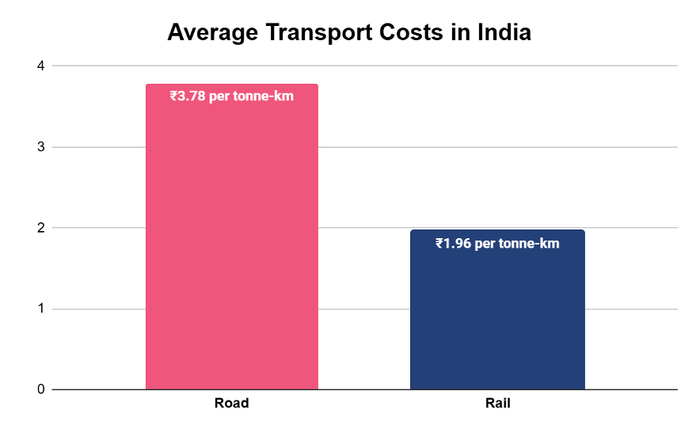
Furthermore, an estimated average transport cost is ₹1.96 per tonne-km for rail compared with ₹3.78 per tonne-km for road. At the same time, logistics costs can account for as much as 16.9% of output for businesses with turnover up to ₹5 crore, compared with 7.6% for firms with turnover above ₹250 crore2.
Why Rail Freight Could Be Better Than Road Transport for MSMEs
Rail freight can offer MSMEs a stronger cost advantage when shipments are long-distance, regular and large enough to benefit from rail’s capacity. However, the actual savings depend on how well rail fits the business’s route, shipment size and access to freight infrastructure.
The benefit is particularly relevant to smaller businesses because logistics accounts for a larger share of their costs. A few rupees saved per tonne may appear modest, but the impact can be substantial when the same route is used regularly, and the annual volume is high.
Rail can also suit businesses moving larger or recurring consignments. Instead of arranging separate road vehicles repeatedly, suitable cargo can be moved by wagons, rakes, containers, or parcel services, depending on shipment size and the route. The opportunity strengthens when shipments are frequent enough for businesses or logistics providers to plan aggregation.
Reach is another advantage. Indian Railways has more than 69,000 route km and over 3,500 freight-handling locations3, creating a large national network that can potentially connect MSME production clusters with major consumption centres.
However, while rail may have a lower long-distance transport rate, terminal access, handling, cargo aggregation, service uncertainty and first- and last-mile transport can reduce or even remove that advantage.
These factors make rail worth considering, but not automatically suitable for every shipment. The following seven questions can help small businesses assess the actual fit.
These factors make rail worth considering, but not automatically suitable for every shipment. The following 7 questions can help small businesses assess the actual fit.
1. How Far the Goods Need to be Transported
Rail becomes more cost-effective to consider as the distance of the shipment increases. Rail and road costs can become comparable for shipments travelling around 500-600 km. Beyond this distance, businesses may have a stronger reason to compare rail with road, although rail will not always be the cheaper option. For example, an MSME moving goods 100 km to a nearby customer may find direct road transport simpler. A manufacturer that repeatedly supplies customers 800 or 1,000 km away has more reason to assess whether rail transport can reduce costs. Distance should therefore be assessed together with the complete route, including the road journey at both ends.
2. Size and Frequency of the Shipment
Rail has traditionally been associated with large quantities of cargo. MSMEs, on the other hand, often move smaller consignments, and this mismatch is one reason rail can be difficult for them to use. A business should first calculate its average shipment size and frequency. Large and regular volumes may justify wagon or rake-based movement. Smaller consignments may be more suitable for railway parcel services or for consolidation with cargo from other businesses.
Indian Railways states that parcel services are intended for smaller packages, while businesses can also request an entire parcel van where required. Aggregation can become particularly important when one MSME does not generate enough cargo on its own. Shared logistics hubs, container or wagon-sharing platforms and freight aggregation services are a few ways smaller businesses could gain better rail access.
3. Hidden Expenses: The Total Logistics Cost, Not Just the Freight Rate
A comparison based only on the rail and road freight quotation can give an incomplete picture. The better measure is what the business finally spends to move goods from its premises to the customer. For rail, this may include transport from the factory to the terminal, loading and unloading, handling, storage and transport from the destination terminal to the buyer. Businesses should also consider inventory carrying costs, extra stock required to manage uncertain delivery times and possible damage or losses.
Indian Railways provides freight-calculation facilities for estimating transport charges. These estimates can form the starting point, but MSMEs still need to add the costs incurred before and after the rail journey.
4. Access to Suitable Rail Freight Terminals
A railway line passing through a district does not necessarily mean that a business has convenient freight access. The capabilities of the nearest freight terminal matter just as much as its location. An MSME should check how far the suitable terminal is from its factory or warehouse and what facilities are available there. The assessment can include loading and unloading equipment, storage space, vehicle access and whether the terminal can handle the type, weight and dimensions of the goods.
This is especially important for products requiring careful handling or specific equipment. Many smaller businesses depend on common-user terminals, which may not offer the same level of mechanisation, storage and integrated logistics services available at more modern freight facilities.
A low freight rate becomes less useful if accessing the terminal itself is costly or difficult.
5. Time-Sensitivity of the Goods
Cost is only one part of a logistics decision. Delivery time and predictability can be equally important, particularly when an MSME is working with limited inventory or strict customer deadlines.
Businesses transporting seasonal merchandise, perishable goods or inputs needed for continuous production need to examine realistic transit schedules rather than only expected travel time.
A delay can create costs elsewhere. A manufacturer may need to hold more stock as a buffer. A trader may miss a seasonal sales period. Perishable goods may face spoilage risks.
Thus, transit time, uncertainty and inventory-related expenses can offset rail’s lower line-haul cost. The decision should therefore consider whether the expected savings justify the delivery schedule and level of predictability available on the route.
6. Local Transport Links
Even when rail covers most of the journey, road transport is usually still needed at both ends. For MSMEs, these first- and last-mile connections can determine whether rail is commercially practical. A business needs to understand how goods will move from the factory to the departure terminal and from the arrival terminal to the customer. Distance, road conditions, truck availability, local restrictions and the number of handling stages can all affect costs.
If the terminal is far from the production unit or buyer, local transport charges may consume a large part of the savings generated by rail. Repeated loading and unloading can also increase handling time and the possibility of damage. This is why first- and last-mile connectivity is one of the major accessibility challenges facing MSMEs.
7. Booking and Aggregation
Once rail appears suitable on cost, distance and timing, the final question is whether the shipment can be booked conveniently and in the required format.
MSMEs should clarify whether the cargo requires a wagon, rake, parcel van or normal parcel booking. Wagon availability, suitable terminals, payment requirements and the possibility of using an aggregator or logistics service provider should be checked before committing delivery dates to customers.
Indian Railways provides digital facilities through FOIS and the RailSAHAY freight business portal for freight-related services, including electronic demand registration. Indian Railways’ e-Demand system allows registered consignors to place wagon demand electronically.
For smaller consignments, the Indian Railways Parcel portal provides information on booking procedures, approximate freight, parcel trains and advance booking. Parcel space can be booked up to 120 days in advance.
Documentation should also be checked early. Indian Railways requires a Forwarding Note containing details of the consignment, consignor and consignee for parcel booking. Its guidance also specifies requirements related to e-way bills where applicable.
Completing these checks before dispatch can reduce last-minute delays at the terminal.
—
1 FICCI-KPMG Report, Unlocking Rail Freight Growth: Making Rail Accessible for India’s MSMEs, July 2026
2 FICCI-KPMG Report, Unlocking Rail Freight Growth: Making Rail Accessible for India’s MSMEs, July 2026
3 FICCI-KPMG Report, Unlocking Rail Freight Growth: Making Rail Accessible for India’s MSMEs, July 2026
—