
Empowering MSMEs with ₹25,060 Crore Export Promotion Mission for International Success
- The Union Cabinet’s recently-approved ₹25,060 crore Export Promotion Mission (EPM) creates a single, digitally managed framework that shifts export success toward preparedness, compliance discipline, and execution reliability rather than fragmented incentives.
- By combining financial support under Niryat Protsahan with market- and capability-building support under Niryat Disha, the Mission directly addresses the operational gaps that prevent many MSMEs from becoming consistent exporters.
- MSMEs aiming to enter global markets must move beyond flexible domestic practices and build export-grade capabilities, including product standardisation, repeatable quality systems, accurate documentation, and disciplined logistics.
- First-time exporters in 2026 will need to treat export readiness as a planned operational transition, focusing on cost structuring, supply chain reliability, digital record-keeping, and predictable delivery timelines.
- Structured financing from RBI-registered NBFCs like Protium can play a critical role in enabling MSMEs to invest upfront in export readiness, manage longer working capital cycles, and scale exports sustainably beyond the first shipment.
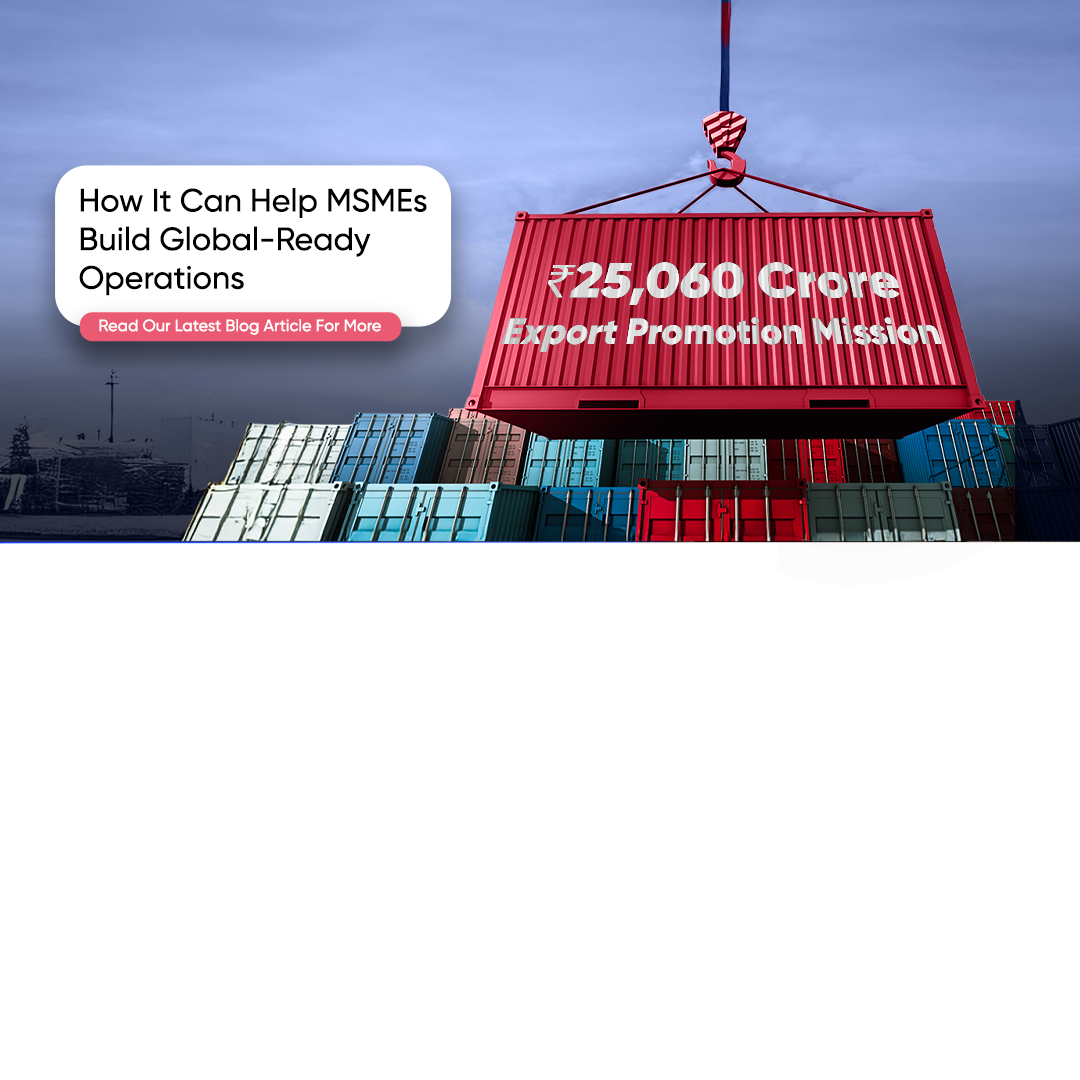
The Union Cabinet has approved a ₹25,060 crore Export Promotion Mission (EPM) announced in the Union Budget 2025–26. The Mission includes an additional ₹20,000 crore credit guarantee expansion[1] to ease liquidity pressure on MSMEs, first-time exporters, and labour-intensive sectors.[1] Designed to strengthen the export competitiveness over a six-year window[2] , it will run on an end-to-end digital system managed through the Directorate General of Foreign Trade (DGFT). This single system will make approvals and delivery faster, more transparent, and paperless.
The EPM aims to create a structure for MSMEs with strong products but lacking export-ready operations. In other words, it will provide exporters that need standardised specs, consistent quality, traceable batches, packaging rules, accurate documentation, and delivery discipline. [3]
What the Export Promotion Mission Means for MSMEs
The EPM is positioned as a structural clean-up of export support. Instead of multiple fragmented efforts and initiatives, it brings export enablement into a single mission-mode framework that is outcome-linked and digitally managed. This shift is important because it signals what will be rewarded in the next phase of India’s export push: preparedness, compliance discipline, and execution reliability.
The Mission runs through two integrated sub-schemes, each addressing a different gap that first-time exporters typically face:
Niryat Protsahan: This focuses on financial enablers to improve access to affordable trade finance, including pre- and post-shipment credit, export factoring, and export-related credit facilitation for newer exporters and markets.
Niryat Disha: The sub-scheme focuses on non-financial enablers such as testing, certification, audits, branding and packaging support, trade fairs, buyer-seller meets, export warehousing and logistics, inland transport reimbursement for remote districts, and capacity building through clusters and district-level facilitation.
The Mission also focuses on sectors facing tariff-related pressure and on districts with low export intensity, so that export growth is not limited to a few traditional pockets. For MSMEs, this broad design indicates that export readiness is no longer seen as an optional add-on, but is becoming a capability that businesses are expected to build, step by step.
Core Capabilities MSMEs Must Strengthen to Build Global-Ready Operations
The shift from selling locally to exporting requires more than a change in market focus. Many MSMEs are accustomed to flexible adjustments such as minor shopfloor fixes, informal packing practices, or documentation handled at the last stage. While this may work in domestic markets, export markets tend to penalise such informality. Tight timelines, strict compliance checks, and low tolerance for variation mean that operational gaps can quickly translate into rejected shipments, delayed payments, or lost buyers.
To build global-ready operations, MSMEs need to strengthen a set of core capabilities and implement practical steps in 2026.
1. Product Standardisation and Benchmarking
Export buyers expect consistency across every shipment. This begins with standardisation of product specifications such as materials used, dimensions, performance parameters, labelling language, and pack sizes. Even when product quality is high, variations between batches can result in rejection or renegotiation.
Standardisation also simplifies internal operations. Clearly defined inputs and outputs make it easier to plan production schedules, estimate raw material requirements, and avoid last-minute changes that increase cost and risk.
MSMEs need to clearly define product specifications and follow them consistently across production cycles. Locking in key inputs, aligning labels and pack sizes with target market norms, and documenting specifications help reduce variation. Over time, this discipline simplifies production planning, lowers the risk of last-minute changes, and builds buyer confidence through repeatable outcomes.
2. Quality Management That Reduces Surprises
Export readiness depends on quality that can be repeated, not one-time or exceptional output. Buyers look for predictable results across batches, supported by traceability and documented processes.
This does not always require complex systems at the outset. What matters is discipline. Regular checks at critical stages, basic batch tracking, and a clear process to handle deviations can significantly reduce rework, wastage, and shipment delays. Support for testing, certification, and audits under export-readiness initiatives reinforces this shift toward evidence-based quality.
For many MSMEs, this does not require a complex overhaul. The focus should be on building discipline through regular input checks, in-process inspections, and final quality verification. Maintaining simple batch records and ensuring that quality routines are followed even during peak demand periods helps reduce rework, prevent shipment delays, and protect margins over time.
3. Export Documentation and Compliance Readiness
For first-time exporters, documentation often becomes the most underestimated barrier. A shipment can be delayed or held up due to missing declarations, incorrect invoices, mismatched packaging information, or incomplete compliance documentation. While digital export systems reduce friction at the ecosystem level, internal readiness remains critical. Clean records, standard formats, and timely responses to buyer or customs queries make the difference between smooth clearance and costly delays.
MSMEs must treat documentation readiness with the same seriousness as production readiness. Standardising invoice formats, packing lists, and declarations, maintaining digital records, and preparing compliance checklists for each target market allow faster responses to buyer or customs queries. Without clean internal documentation, external systems and faster port processes offer limited relief.
4. Packaging, Labelling, and Logistics Discipline
In export markets, packaging is rarely just a presentation choice. It is often a compliance requirement. Many destinations mandate specific labelling formats, barcode systems, durability standards, and packaging materials that meet safety or environmental norms. In food, marine, and other sensitive categories, packaging also affects shelf life and rejection risk. Distance from ports further complicates logistics for Tier 2 and Tier 3 MSMEs, making advance planning essential.
Export-ready MSMEs need to design packaging around transit realities such as handling stress, humidity, temperature variation, and stacking requirements. Aligning labels and barcodes with importer expectations and factoring in longer inland transport timelines is particularly important for businesses located away from ports. Well-planned packaging and logistics protect the product and improve delivery reliability.
5. Supply Chain Strength and Production Planning
Export orders place greater pressure on supply chains than domestic sales. Reliable exports require dependable suppliers, backup options, and sufficient raw material buffers. Even a short delay in one input can disrupt production schedules and cause missed shipment windows. While policy support may ease regional logistics disadvantages, internal supply discipline remains essential.
In 2026, MSMEs entering exports should focus on formalising vendor relationships, planning production schedules that account for inspection and packing time, and maintaining buffer stock for critical inputs during peak seasons. These steps help avoid emergency procurement and rushed production, both of which increase cost and quality risk.
6. Digital Tools That Improve Accuracy and Credibility
Export operations work best when information is consistent and easily accessible. Digital tools reduce manual errors, improve response time, and enhance buyer confidence. Even simple digital adoption can significantly improve execution for MSMEs.
Adopting simple digital systems for inventory tracking, batch records, document templates, shipment monitoring, and buyer follow-ups can significantly improve execution. When buyers receive timely updates, accurate documents, and clear tracking information, trust improves. In export markets, this trust often determines whether a business receives repeat orders or remains a one-time supplier.
How Financial Solutions can Help MSMEs Achieve Export-Readiness
Export readiness often needs upfront spending before revenues arrive. Testing, certifications, packaging upgrades, better storage, machinery improvements, or capacity expansion typically happen early, while export payments may take longer due to shipment cycles and buyer terms.
This is where structured financing can support the transition from “export interest” to “export execution.” Financing solutions from RBI-registered NBFCs such as Protium can help MSMEs invest in operational upgrades without destabilising day-to-day cash flows, especially when the export cycle extends beyond domestic cycles. Over time, well-financed discipline becomes a competitive advantage. It signals to global buyers that the business can deliver consistently and scale responsibly, not just manufacture well.
MSMEs that start building these capabilities early, supported by structured financing where needed, are more likely to move from first shipment to repeat orders. That is where export growth becomes sustainable, and where smaller businesses begin to operate like long-term global suppliers rather than one-time exporters.