
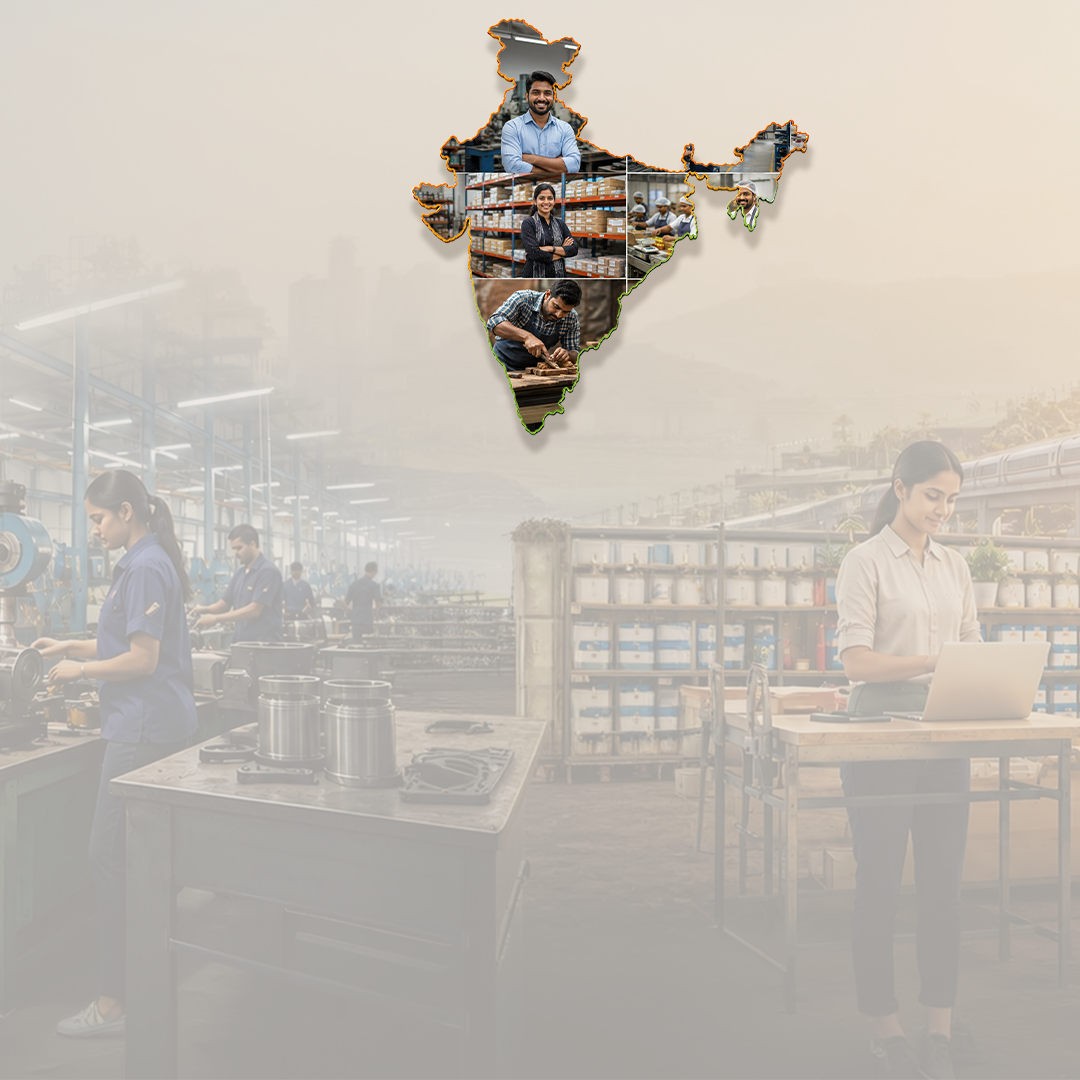
- As India marks 79 years of Independence in 2026, the idea of self-reliance is also evolving. Beyond political and economic freedom, the focus today includes building stronger domestic capabilities in technology, manufacturing, clean energy, skills, and supply chains.
- Self-reliance is creating new opportunities for MSMEs. Stronger domestic supply chains mean growing scope for small businesses as manufacturers, suppliers, service providers, and technology partners.
- MSMEs playing an integral role can find more opportunities across India’s emerging growth sectors, including I, 6G, semiconductors, defence, and solar and clean energy. Small businesses can contribute through manufacturing, assembly, testing, software, maintenance, logistics, and specialised services. Building the right skills, certifications, partnerships, and financial readiness can help them access these opportunities more effectively.
Bharat’s idea of self-reliance is increasingly including the ability to develop technology domestically, strengthen domestic supply chains, build cleaner industries and prepare a skilled workforce for emerging opportunities.
This makes the Government’s theme “Honouring Freedom, Inspiring the Future” particularly relevant for India’s MSMEs. Small businesses may operate from industrial clusters, workshops, markets and commercial centers across the country, but their capabilities are closely connected to many of India’s larger ambitions.
The Economic Survey 2025-26, for instance, specifically points to deeper participation in supply chains as an important part of India’s broader Viksit Bharat 2047 growth ambitions. As India builds new capabilities in technology, defense, clean energy and other sectors, MSMEs have an opportunity to find their place within these emerging value chains.
Indigenous Technology: Building India’s Capabilities at Home
India’s technology ambitions are moving into areas that were once largely associated with a small number of global technology leaders. Artificial Intelligence and next-generation telecommunications are two examples.
The IndiaAI Mission, approved with an outlay of ₹10,371.92 crore, covers areas such as computing capacity, datasets, application development, future skills and startup financing1. Importantly for small businesses, the government is also taking measures to promote AI and digital technology adoption among MSMEs.
India is also preparing for the next generation of telecommunications. Under the Bharat 6G Vision, 104 projects worth ₹271 crore had been approved for 6G research and development by February 2026. The Bharat 6G Alliance had expanded to 90 members by July 2026, bringing together telecom companies, equipment manufacturers, startups, research institutions and academia2. Government support also covers testbeds, research and participation by eligible MSMEs and startups in telecom standardisation initiatives.
This drive toward self-reliance is visible well beyond AI and telecom. In defence, rising indigenous R&D spending and private-sector participation are powering advances in missile systems, naval platforms and counter-drone technology, alongside a growing defence export base. In space, ISRO is deepening India’s sovereign capabilities through the Gaganyaan human spaceflight programme, new small-satellite launch vehicles and indigenous propulsion and secure-communication systems. The fisheries sector is undergoing a similar shift, with deep-sea submersibles, offshore aquaculture and digital platforms for fishers modernising what was once a largely traditional industry. And in pharmaceuticals, Indian companies and research institutions are building homegrown AI-driven drug discovery capabilities, positioning the country as a serious partner in global biopharma research and manufacturing.
For MSMEs, opportunities can emerge in electronics assembly, precision manufacturing, equipment enclosures, testing, software services, maintenance, installation and other supporting activities. But the first step is capability. Businesses that want to serve technology-led industries may need stronger quality systems, better-trained teams and greater consistency in production.
The Semiconductor Mission and Opportunities Across the Value Chain
Semiconductors provide another example of how one major national initiative can create activity across several supporting industries. The India Semiconductor Mission has been established to develop a domestic semiconductor and display ecosystem and strengthen India’s position in electronics manufacturing and design. Government support under different semiconductor schemes covers fabs, packaging facilities and semiconductor design.
The ecosystem around a semiconductor plant is wide. Large facilities require industrial equipment, electrical systems, specialised packaging, tooling, testing infrastructure, safety products, maintenance services, logistics and trained manpower. Thus, small businesses can instead map their existing capabilities against requirements emerging around new electronics and semiconductor clusters.
However, technology supply chains also place a strong emphasis on precision and reliability. MSMEs looking at these opportunities may therefore need to strengthen certifications, traceability, quality control and delivery systems before approaching larger buyers.
Atmanirbhar Defence: Expanding the Domestic Supplier Ecosystem
India’s push towards self-reliance in defense shows how domestic manufacturing can gradually create room for a much wider supplier network. India’s defence production reached a record ₹1.78 lakh crore in FY 2025-26, with the private sector contributing about ₹42,000 crore. The domestic defence ecosystem now includes nearly 17,000 MSMEs, alongside Defence Public Sector Undertakings and larger private manufacturers3.
The opportunity is also becoming more structured. By May 2026, more than 15,700 defence items had been indigenized over five years through initiatives including the Srijan Defence Portal and Positive Indigenisation Lists. Domestic orders worth ₹9,782 crore had been placed by Defence Public Sector Undertakings, supporting MSMEs, startups and other participants in the ecosystem. Small businesses can explore requirements in machining, fabrication, electronics, components, software, testing, repair and maintenance.
The path, however, requires preparation. Vendor registration, certification, testing requirements, production capacity and technology upgrades need to be assessed before investment is made.
Green Transition: Turning Sustainability into a Business Opportunity
India’s future growth is also being shaped by the transition towards cleaner energy and more efficient use of resources. For MSMEs, this transition can create opportunities on two sides: businesses can become more sustainable themselves, and some can become suppliers to the growing green economy.
Mission LiFE encourages changes in consumption and production around areas such as energy, water, waste and sustainable lifestyles. The Ministry of MSME is also supporting greener practices through initiatives such as MSME Sustainable (ZED), MSE-GIFT and MSE-SPICE.
At the same time, newer industries are developing. The National Green Hydrogen Mission aims to make India a global hub for the production, use and export of green hydrogen and its derivatives. Its framework includes manufacturing, infrastructure, supply chains, research and skill development.
Solar energy is expanding as well. By July 22, 2026, around 39.7 lakh rooftop solar systems had been installed under PM Surya Ghar, benefiting more than 48 lakh households4. Growth at this scale can support demand for installers, electrical contractors, component suppliers, maintenance businesses and other local service providers.
Even if an MSME does not enter the renewable energy business, the opportunity for them may simply be reducing electricity use, material waste, fuel consumption or production losses. Sustainability can therefore become both a market opportunity and a way of improving operating efficiency.
Youth and Skill Development: Preparing the Workforce for Emerging Sectors
Besides patriotic fervor, this year’s Har Ghar Tiranga Campaign also calls for celebrating the spirit of freedom while inspiring citizens, especially the youth, to contribute towards building a stronger, self-reliant, innovative, and future-ready India. Skill development thus becomes relevant because new technology can only create lasting growth when businesses have people who know how to use it. As machinery, digital systems, renewable energy and advanced manufacturing evolve, skills will need to evolve alongside them.
The Skill India Mission currently operates through initiatives including PMKVY, Jan Shikshan Sansthan, the Craftsmen Training Scheme through ITIs and the National Apprenticeship Promotion Scheme (NAPS). These programs focus on developing industry-relevant and future-ready skills.
Apprenticeships are particularly relevant for MSMEs because they connect learning with actual workplace requirements. As of June 30, 2026, 33,319 MSME establishments across India had engaged apprentices under NAPS5.
Small businesses can therefore consider skill development as part of growth planning rather than only recruitment. Partnerships with ITIs, polytechnics and skill centres, along with structured apprenticeships and training for existing employees, can help businesses build the capabilities required for newer industries.
Inclusion: Taking Future Opportunities Beyond Major Cities
For the Viksit Bharat vision to be broad-based, opportunities in technology, manufacturing, sustainability and services cannot remain concentrated only in India’s largest metropolitan areas.
This is where MSMEs in Tier-2 and Tier-3 cities can make a distinct contribution. Local enterprises understand regional markets, employ locally and often form the link between national supply chains and smaller industrial centers.
Formalisation and digital access can strengthen that link further. Registration, digital financial records, online procurement platforms and stronger compliance practices can help businesses become more visible to institutional buyers and larger companies.
Inclusion is therefore not just about where a business is located. It is about whether businesses across different parts of India have access to the skills, technology, markets and finance required to participate in the country’s next phase of growth.
What MSMEs Can Do to Prepare for India’s Next Growth Phase
As India moves towards Viksit Bharat 2047, MSMEs can prepare by strengthening their capabilities, improving business readiness, and identifying where they can contribute to emerging growth sectors.
1. Map Existing Capabilities
MSMEs can first assess how their current products or services may fit into sectors such as technology, electronics, defense, renewable energy, or advanced manufacturing. The focus should be on adjacent opportunities rather than moving into an entirely unfamiliar area.
2. Upgrade with a Clear Business Need
Investments in machinery, digital systems, certifications, quality control, or employee training should support a specific requirement. Upgrades are most useful when they help improve productivity, meet buyer standards, or increase production capacity.
3. Strengthen Business Readiness
Updated registrations, financial records, compliance documents, and certifications can make it easier for MSMEs to work with larger companies or participate in formal procurement opportunities.
4. Build the Right Partnerships
Small businesses can collaborate with larger manufacturers, technology providers, local suppliers, or other MSMEs to become part of wider supply chains. A specialised role can often be more practical than trying to manage an entire value chain independently.
5. Use Finance at the Right Stage
Business finance can support machinery purchases, technology upgrades, inventory, or working capital when there is a clear demand opportunity or capacity requirement. The aim should be to link borrowing with a defined path to business growth.
India’s freedom created the opportunity for generations to build institutions, businesses and industries of their own. As the country looks towards 2047, that idea of independence is taking another form: stronger domestic technology, resilient supply chains, cleaner growth and opportunities that reach more parts of the country.
For India’s MSMEs, honouring freedom can therefore also mean preparing for what comes next — and helping build an India that is increasingly capable of designing, producing and growing on its own terms.
—
1 Ministry of Micro,Small & Medium Enterprises
2 Ministry of Communications, PIB, Development of 6G Technology, March 2026
3 DD News, India’s defence production hits record Rs 1.78 lakh crore in FY26
4 Ministry of New and Renewable Energy, PIB, July 2026
5 Ministry of Skill Development and Entrepreneurship