

₹12.2 Lakh Crore Public Capex in FY 2026-27: 5 Growth Areas MSMEs Should Track
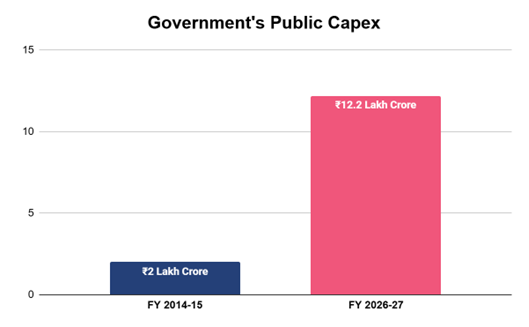
- Government of India’s public capital expenditure has increased nearly six-fold, from about ₹2 lakh crore in FY 2014-15 to ₹12.2 lakh crore for FY 2026-27, reflecting continued focus on infrastructure-led development.
- MSMEs can find growth opportunities across construction, logistics, EV infrastructure, engineering, fabrication, electrical services, traditional clusters, and local support services by preparing early with better capacity, documentation, working capital planning, and formal credit access.
The Government’s public capital expenditure has increased nearly six-fold, from about ₹2 lakh crore in FY 2014-15 to ₹12.2 lakh crore for FY 2026-271. The continued rise reflects the focus on infrastructure-led development, which includes freight corridors, waterways, high-speed rail corridors, city economic regions, industrial clusters and logistics. For MSMEs, this creates opportunities beyond direct government contracts. Small businesses can become part of the wider ecosystem that supports projects such as highways, rail corridors or large public facilities. Opportunities can emerge through materials supply, subcontracting, repair work, fabrication, transportation, manpower support, equipment maintenance and local services around new project sites.
The important question for MSMEs in 2026 is not only where growth is happening but how they can identify the right opportunity, prepare early, and avoid taking on work that stretches their capacity or cash flow.
Why 2026 Can Open New Growth Avenues for MSMEs
Public infrastructure spending can create demand across many connected sectors. For example, a road project does not need only a large contractor but also cement products, steel items, safety material, transport support, equipment repair, site labour, electrical work, fuel supply, food services and local accommodation. This wider chain can create practical opportunities for MSMEs.
Growth may come from supporting the above requirements and serving new demand in industrial and construction clusters. This is especially relevant for MSMEs in Tier-2 and Tier-3 cities, because many infrastructure projects pass through smaller industrial belts, logistics routes, market towns and district-level business centres. However, MSMEs need to choose carefully. Every new project does not become the right business opportunity.
A small business must assess whether it has the skills, working capital, documentation, equipment and manpower needed to deliver on time. The right opportunity is one that matches existing strengths and can be scaled with discipline. After considering these factors, here are the opportunities small businesses can explore in the infra sector.
1. Construction and Building Materials Demand
Construction can be one of the clearest beneficiaries of higher infrastructure spending. Roads, rail corridors, waterways, city development projects, industrial areas and public facilities can increase demand for small contractors and material suppliers. MSMEs already working in construction-linked activities can look for orders that match their capacity.
There may be demand for cement products, steel fabrication, bricks, blocks, tiles, pavers, sand, aggregates, ready-mix support, electrical fittings, plumbing materials, paints, finishing products, scaffolding, shuttering tools and site safety equipment. Small contractors may also explore subcontracting work for civil works, interiors, repairs, boundary walls, drainage, flooring and maintenance.
Practical steps for MSMEs
Track projects coming up near their district or industrial area: A business located near a highway expansion, railway project, logistics park or industrial cluster may have a better chance of supplying nearby contractors. Local delivery capability can become an advantage because large contractors often need reliable suppliers who can respond quickly.
Strengthen capabilities: Before accepting larger orders, MSMEs should strengthen GST records, vendor registration, cost estimates, labour planning and equipment availability. Construction-linked work often involves tight timelines and delayed payments. A small business should calculate material cost, transport cost, wages and credit period before agreeing to a price.
2. Transport, Logistics and Warehousing Opportunities
Infrastructure growth increases the movement of goods, people, equipment and raw materials. The Budget also proposed new Dedicated Freight Corridors and operationalization of 20 new National Waterways over five years, as per the Press Information Bureau. Such plans can support cargo movement and create new business needs around transport, storage and handling.
MSMEs can find opportunities in local transport, last-mile delivery, loading and unloading services, packaging, small warehousing, cold storage support, fleet maintenance, driver services and manpower support. Businesses located near industrial corridors, ports, railway hubs, transport routes and highways may benefit from increased demand for goods movement and storage.
Practical steps for MSMEs
Focus on basic maintenance: Small logistics operators should focus on vehicle maintenance, route planning, fuel cost tracking and formal billing. These basics matter because logistics margins can reduce quickly if fuel use, repairs and delays are not monitored. MSMEs should also maintain proper trip records, driver payments, customer invoices and vehicle documents.
Manage working capital: Working capital is important in this segment. Transport businesses often need funds for fuel, tolls, repairs, insurance, wages and vehicle maintenance before customer payments come in. A business should avoid taking up high-volume transport work without checking whether it can manage the payment cycle.
3. EV Infrastructure and Auto-Linked Services
India’s infrastructure and EV push can open opportunities for MSMEs in charging support, electrical work, component supply and servicing. As charging networks, mobility services and EV-linked facilities expand, small businesses can participate in supporting roles.
MSMEs can explore EV charger installation support, electrical wiring, panel work, fabrication of charger stands and enclosures, battery handling support, repair and maintenance services, parking and charging facility management, spare parts supply and small component manufacturing. Existing garages and workshops can also upskill teams for EV diagnostics, battery safety and electrical systems.
Small manufacturers may find opportunities in brackets, sheet metal parts, cable trays, fasteners, protective enclosures and other supporting components. These may appear small compared to the main EV system, but such components are often needed in large numbers when charging and service networks expand.
Practical steps for MSMEs
Focus on training and safety preparedness: Battery systems, electrical loads and charging infrastructure require proper knowledge. Business owners should evaluate certification needs, safety standards, manpower training and clear costing before investing in this space.
4. Engineering, Fabrication and Capital Goods
Infrastructure projects require machinery, tools, fabricated parts, repair support and custom components. This creates opportunities for MSMEs in engineering clusters and small manufacturing hubs. The focus on strengthening capital goods capability and reviving legacy industrial clusters also supports this direction.
MSMEs can benefit through machine parts, sheet metal fabrication, welding and cutting services, industrial tools, maintenance parts, conveyor components, pump and motor repair, industrial sheds and structural frames. Small units that already serve factories, contractors or local industries can use this period to build stronger vendor relationships.
Practical steps for MSMEs
Improve production planning and delivery reliability: For many engineering MSMEs, the main challenge is capacity. A unit may have skilled workers but outdated machinery. Another may have machines but weak quality checks. Some may depend too much on one buyer. Infrastructure-linked demand can help such businesses diversify if they enhance their production planning and make delivery reliable.
5. Electrical, Energy, Traditional Cluster and Local Service Opportunities
Infrastructure growth usually increases demand for power connections, lighting, cabling, backup systems and maintenance. MSMEs in electrical and energy support services can explore electrical contracting, cable laying, panel assembly, solar installation support, generator maintenance, LED lighting supply, energy audits for small facilities and repair of motors, pumps, and transformers.
Traditional sectors can also benefit when cluster-level infrastructure improves. MSMEs in textiles, handloom, handicrafts and local manufacturing clusters may see better access to machinery, testing facilities, branding support, market linkage, sustainable production practices and skill development.
Infrastructure development can also increase travel, worker movement and local commercial activity. New corridors, city economic regions and tourism-linked development can create demand for food services, transport, repair workshops, budget accommodation, laundry services, local retail, packaging supply, maintenance and housekeeping. These may not be direct infrastructure contracts, but they can still create steady local income.
Practical steps for MSMEs
Maintain safety documents and clear service records: Small electrical businesses should maintain licenses, safety compliance, trained manpower, and proper purchase records. Reliable documentation can help them qualify for larger orders and institutional clients. This is important because many contractors and companies prefer vendors who can provide formal invoices, safety documents and clear service records.
MSMEs can also prepare by improving product consistency, packaging, digital catalogs, buyer records and production planning.
How MSMEs Can Identify the Right Opportunity
The right opportunity should pass three simple checks. First, the business should already have some skill, equipment, supplier access or market understanding. Second, the order size should match working capital capacity. Third, the payment cycle should not disturb regular business expenses. If these three points are weak, the opportunity may look attractive on paper but become difficult in practice.
MSMEs should begin by mapping projects coming up near their city, district or industrial area. Useful sources can include government tender portals, state industrial development corporation updates, district industry centers, local contractor networks, industry associations, chamber of commerce meetings and supplier registration portals of large companies.
Business owners should not chase every opportunity. A small fabrication unit, for example, may be better placed to serve construction, logistics or EV infrastructure than to enter an unrelated sector. A transport operator may benefit more by improving fleet utilization than by investing in manufacturing. A local trader may find better returns in becoming a reliable supplier to contractors rather than expanding into a new product line without experience.
Role of Credit in Capturing Growth
MSMEs may need timely finance to participate in infrastructure-linked opportunities. Larger orders often require upfront spending on raw materials, machinery, tooling, equipment, vehicle repair, wages, inventory stocking, site mobilization, security deposits or advance expenses. Without planned finance, even a good order can create cash-flow pressure.
A Loan Against Property, Machinery & Equipment Loan or Business Loan from an RBI-regulated NBFC such as Protium can support MSMEs. A machinery loan may help with equipment upgrades. A business loan may support working capital needs. A Loan Against Property may help established MSMEs access larger funds for expansion or long-term business requirements.
In 2026, infrastructure-led growth can become a practical opportunity for MSMEs when preparation, capacity and financial planning move together.
————–
PIB, Infrastructure at the Core of India’s Development, June 2026