
5 Reasons NBFCs are Driving 14% MSME Credit Growth in India
- MSME lending is expected to grow at around 14% in FY2026.,
- To fill the ₹30 trillion credit gap, NBFCs have stepped in to fill this structural void through faster and more flexible financing.
- As credit suitability and timing become as important as availability, strategic financing decisions will directly influence MSME growth outcomes in 2026.
- This blog article examines what is driving MSME credit demand, the structural challenges that continue to restrict access, and how NBFCs are becoming a more relevant financing channel. It also outlines what this shift means for MSMEs on the ground and how businesses can approach financing decisions more effectively to support stable and timely growth.
MSME lending is expected to grow at around 14% in FY2026, driven by a strong momentum across manufacturing, trade, and services1. This is due to several MSMEs entering a phase where growth is more structured and opportunity-driven. Expansion-led demand is visible across sectors, with businesses investing in machinery, upgrading production capabilities, and preparing to handle higher order volumes.
Some of the primary reasons for the rise in MSME credit demand include:
- Upgradation and Modernization: Many units are moving from manual to semi-automated processes, requiring capital or machinery specific loans that support the upgradation of machinery equipment and its ancillary.
- Working Capital Requirements: Payment cycles often lengthen, which increases the need for short-term funding that can bridge operational gaps without disrupting day-to-day business.
- Inventory management: In order to ensure that MSMEs don’t lose their customers, they have to ensure Inventory is maintained at higher levels so orders are fulfilled despite supply chain pressures.. This would require seeking short-term funding or working capital loans that can support daily operations without slowing down business activity.
- Supply Chain Integration: Participation in export markets and larger supply chains is adding another layer to financing needs. This is due to businesses taking up orders that require upfront investment, and upfront payments. For example, an MSME in the powerloom industry who is exporting their manufactured cloth to an African nation is forced to make upfront payment to procure raw materials; and ends up waiting for their payment until the shipment is delivered. The MSME is also heavily dependent on their logistics partners to ensure alternate options are considered in case there are supply chain disruptions. Situations like these increase the need to fall back on structured financing options that can support the full cycle of production and delivery.
- Digital Trail: Formalisation is improving how MSMEs are viewed within the financial system. GST filings, digital transactions, and organised record-keeping are making business performance more visible. Digitalisation increases credit eligibility, and raises expectations around faster and more relevant financing solutions.
Despite the optimistic growth projections, a staggering ₹30 trillion credit gap remains2. For a small business owner in a Tier-2 or Tier-3 town, the problem is often not the unavailability of money but the fact that the funding doesn’t fit the small enterprise’s business reality.
The gap lies in the mismatch between traditional loan products and the actual cash-flow cycles of a business. Many MSMEs face delays in sanction and disbursement, which can lead to missed order deadlines. Furthermore, the rigid collateral requirements of traditional banks often exclude high-potential businesses that operate in rented premises or have most of their value tied up in inventory and receivables rather than land.
Non-Banking Financial Companies (NBFCs) have stepped in to fill this structural void as the evolving needs of MSMEs are being matched by changes in the lending ecosystem.
Why NBFCs are Becoming More Important in MSME Financing
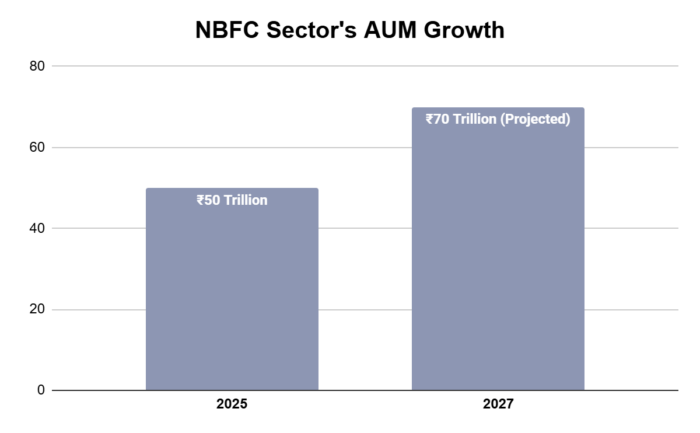
NBFCs are emerging as a key channel in addressing these requirements. The NBFC sector has grown significantly, with assets under management (AUM) crossing ₹50 trillion in FY2025 and projected to reach ₹70 trillion by FY2027. This growth reflects their increasing role in supporting MSME financing. Here’s why NBFCs are proving to be the go-to lenders for MSMEs:
- Faster turnaround times: RBI registered NBFCs such as Protium Finance Ltd are a preferred option for MSMEs that need immediate access to funds because their turnaround time for evaluating a loan application is usually less than 10 days. Once the loan is approved, the disbursement of the funds happen within 48 hrs in several cases; making it extremely convenient for those MSMEs who are seeking loans for working capital or inventory purchase requirements.
- Eligibility criteria: NBFCs often follow more practical eligibility criteria, which helps a wider set of MSMEs access formal credit. This is especially relevant for businesses that may not meet the stricter requirements of traditional lenders but have stable operations, regular cash flows, and clear business potential.
- Flexibility in loan structuring: NBFCs also offer flexibility in loan repayment structures that align with business cash flows and operational cycles, making it easier for MSMEs to manage repayments while maintaining their daily cashflows.
- Reach across Tier-2 and Tier-3 markets: Several NBFCs are actively increasing their physical presence in emerging business clusters and industrial belts to offer relevant business loan products after a deep understanding of local conditions.
- More practical assessment approaches: Alongside collateral-based lending, there is a growing focus on cash-flow-based evaluation, which allows a wider range of businesses to access credit.
- Broader product mix: Varied financial solutions are supporting different business needs. Working capital loans help manage short-term operational gaps, machinery and equipment finance supports production expansion, and loan against property provides an option for longer-term funding and liquidity.
- Use of technology:
Technology and data-based processes are helping NBFCs simplify the borrowing journey for MSMEs. RBI-regulated NBFCs are such as Protium can keep documentation requirements minimal because part of the required information can be accessed through approved government portals. This helps reduce paperwork, improve processing speed, and make credit access more convenient for businesses.
For MSMEs, the importance of NBFCs is visible in day-to-day business operations. Growth plans become easier to execute when financing is timely and flexible. It also helps when loan products are aligned with actual business needs.
How NBFC Growth is Changing MSME Financing
Financing decisions are becoming central to business execution. Whether it is taking on a new contract, expanding capacity, or entering a new market, timely access to funds plays a direct role in outcomes.
Businesses that are able to align financing with their operational needs are better positioned to scale. Structured planning and disciplined financial management allow MSMEs to move forward with greater clarity and stability.
Source:
1 ICRA–ASSOCHAM MSME Lending Report March 2026
2 ICRA–ASSOCHAM MSME Lending Report March 2026