

A 3-Phase Approach for MSMEs to Scale Through India’s $300 Billion E-Commerce Boom
- E-commerce is becoming a serious growth channel for MSMEs, as India’s online market approaches $300 billion, providing small businesses with a wider opportunity to expand beyond local demand.
- Its scale depends on operations as much as visibility. Inventory, storage, delivery, and working capital planning determine whether digital demand can turn into long-term business growth.
India’s e-commerce market is projected to grow from about $120–140 billion in 2024 to $300 billion by 2030, driven by 15-17% CAGR. Over the same period, e-commerce’s share of overall retail could rise from around 6% to as much as 11%. A large part of this expansion is expected to come from smaller cities, where digital demand is rising, and entry barriers are becoming lower through marketplaces, social commerce, and other online selling models.¹
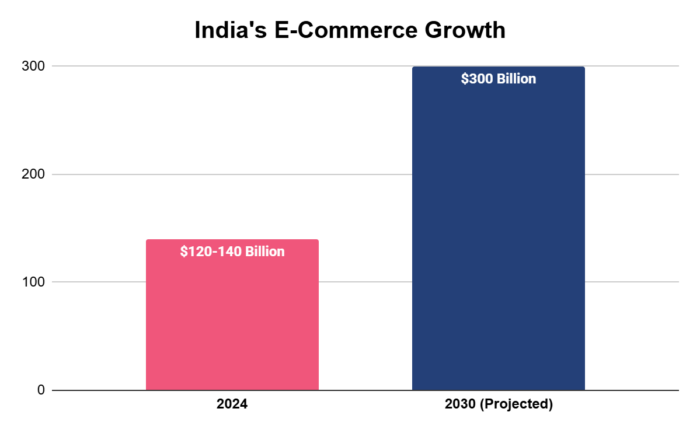
For MSMEs, this changes the role of e-commerce. It is no longer limited to creating an online presence or listing products on a marketplace. It is becoming a practical route to expand beyond limited physical locations, reach more buyers without opening new outlets, and build a more scalable sales model. Businesses that approach e-commerce with operational discipline rather than only promotional intent are likely to be in a stronger position as this market grows.
E-commerce as a Growth Route for MSMEs
For many MSMEs, growth has traditionally depended on location, footfall, and access to distributors. E-commerce changes that equation. A business that was once restricted to a local market can now reach customers through search visibility, platform discovery, digital communication, and logistics access. This allows smaller businesses to think beyond the boundaries of one neighbourhood, one city, or one existing trade network.
The structure of online commerce is also becoming broader. MSMEs are no longer dependent on only one route to sell online. Alongside major marketplaces, businesses can use catalogue-led selling, social commerce, and direct channels to begin building digital demand. This means small businesses do not need to start with a large budget. They need a product that travels well, a digital storefront customers can trust, and a delivery process that supports repeat orders.
This is particularly relevant for MSMEs in Tier-2 and Tier-3 markets. Many such businesses already have viable products and stable local demand, but their growth remains constrained by geography. E-commerce offers them a way to test wider markets without making large investments in physical expansion. That makes it a growth route with lower upfront risk and more room for step-by-step scaling.
Practical Pathway from Offline to Online Growth
The shift from offline to online should begin with business readiness, not advertising. MSMEs that rush into digital selling without preparing products, listings, and fulfilment systems often face delays, returns, poor reviews, and margin pressure.
A stronger approach is to move in phases, with each stage building the foundation for the next.
Phase 1: Test with the Right Product Set
The first step is not to take the full catalogue online. MSMEs are usually better served by starting with a smaller set of products that are easier to ship, easier to explain, and more likely to generate repeat demand. High-margin or fast-moving SKUs often work better in the early stage because they can absorb packaging, logistics, and platform-related costs more comfortably.
This phase also requires practical judgment. Products with lower breakage risk, simpler packaging requirements, and consistent quality are usually better suited for early online selling. The objective at this stage is to understand demand patterns, pricing response, return behaviour, shipping issues, and customer questions before making larger commitments.
Phase 2: Build a Credible Storefront and Reliable Fulfilment
Once the early signals become clearer, the next step is to strengthen both the customer-facing and backend systems. A full independent website is not always necessary in the beginning. Many MSMEs can start with a marketplace listing, a social commerce page, or a basic digital catalogue. At this stage, the goal is clarity and trust.
That means the product presentation must be clean and usable, with good photos, accurate descriptions, transparent pricing, clear delivery expectations, and responsive contact details. At the same time, fulfilment systems must become more reliable. Stock visibility, dispatch speed, packaging quality, and return handling quickly become part of the customer experience. This is the stage where consistency becomes more crucial than experimentation.
Phase 3: Build Repeat Demand and Scale Gradually
The real strength of e-commerce does not come from attracting first-time buyers alone. It comes from turning a single sale into a repeat-purchase cycle. Once the product, storefront, and fulfilment systems are working, MSMEs can focus on building continuity through reorder prompts, follow-up communication, seasonal bundles, and other simple retention efforts.
Only after the first two stages are stable should the business widen its product range, invest more in direct channels, or expand more aggressively across markets. At that point, performance data can guide restocking, promotion, and channel decisions more effectively. Growth built on this sequence is usually more stable than growth driven only by visibility or discount-led demand.
Why D2C Matters in the Next Phase of MSME Growth
For MSMEs, D2C does not need to mean building a large digital brand overnight. In practical terms, it means owning a greater share of the customer relationship. That includes greater control over pricing, communication, product positioning, and repeat engagement. This is important because marketplace growth alone can create dependence on one platform’s algorithm, pricing environment, or discount structure. A direct channel gives the business a base it can influence more directly. Even when small at the beginning, it helps MSMEs build recall, gather customer signals more clearly, and reduce reliance on intermediaries over time.
D2C can be especially useful for product-focused MSMEs in categories such as food, apparel, lifestyle, home products, personal care, and specialised goods, where repeat buying and customer trust matter strongly. In these segments, a direct relationship can create greater stability than competing as just one listing among many.
A strong example of aligning with e-commerce growth is VSK Online Services, which shows what offline-to-online growth looks like in practice. The business started in Delhi in 2022 with ₹25,000, initially selling bean bags offline in a limited area. As it expanded online to reach more pin codes, the business needed greater inventory, better storage, and stronger infrastructure. It moved from selling about 50 bean bags to a wider product mix that included 1,000 pieces of men’s apparel, and shifted from operating out of a home setup to adding warehouse space. The business later reported turnover growth from ₹49 lakh in FY22 to ₹1.5 crore in FY23, while serving over 50,000 monthly customers across India. The example makes one thing clear: online scale does not come from digital visibility alone. It comes from matching demand with stock, storage, fulfilment, and working capital readiness.
India’s e-commerce market is entering a much larger phase, and MSMEs are expected to drive a significant share of that growth. For small businesses, this creates a real opportunity to expand beyond local physical limits and build a broader sales base without relying solely on traditional distribution.
The businesses most likely to benefit will not be the ones that go online fastest, but those that do so with discipline.
—
¹ Boston Consulting Group (BCG) Report