
Defence Innovation Opportunities for MSMEs Under the DISC-14 and ADITI 4.0, worth ₹625 Crore
- India’s defence production stood at ₹1.54 lakh crore in FY 2024–25, exports at ₹23,622 crore, and approximately 16,000 MSMEs participating in the ecosystem.
- The launch of DISC-14 (Defence India Startup Challenge – 14th Edition) and ADITI 4.0 (Acing Development of Innovative Technologies with iDEX – 4th Edition) has widened access to real defence requirements. They have opened 107 problem statements from the Defence Forces, Indian Coast Guard, and Defence Space Agency, which means MSMEs now have a more structured route into prototype-led and technology-led defence opportunities.
- The opportunity has opened up for MSMEs engaged in precision manufacturing, electronics, embedded systems, materials, testing support, software, rugged components, and specialised engineering services. Defence participation can begin with one strong capability rather than a complete platform.
- The biggest shift is that MSMEs now need to prepare not just as vendors, but as innovation-led partners. Documentation, prototype discipline, quality systems, testing readiness, IP clarity, and timely access to growth capital will matter much more if smaller firms want to convert policy momentum into real defence business.
India recorded its highest-ever defence production of ₹1.54 lakh crore in FY 2024–25, while defence exports rose to a record ₹23,622 crore in the same year. This recent momentum builds on a much larger structural shift. Indigenous defence production reached ₹1,27,434 crore in FY 2023–24, marking a 174% rise from ₹46,429 crore in 2014–15. The government is further targeting ₹3 lakh crore in defence production and ₹50,000 crore in defence exports by 2029., The ₹7.85 lakh crore allocation to the Ministry of Defence in the Union Budget 2026–27 adds further weight to domestic procurement, research, and indigenisation1.
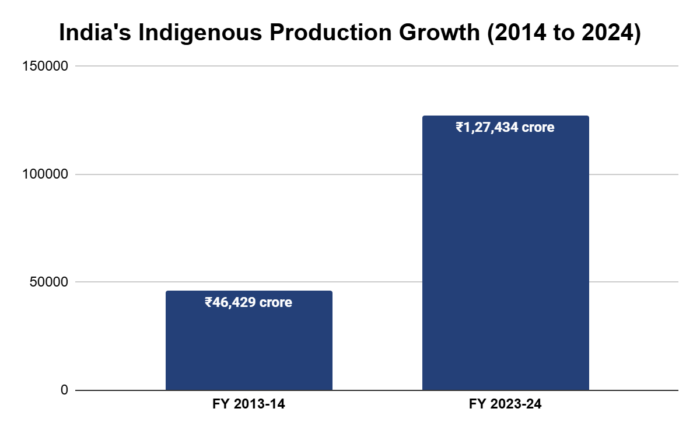
These numbers show that defence is becoming a larger industrial system with room for specialist suppliers, design-led firms, technology developers, and manufacturing partners. For MSMEs, this means defence is no longer only about large contracts won by a few companies, but increasingly about where smaller firms can fit into product development, subsystems, and specialised components.
The Widening Manufacturing Base of India’s Defence
This growth is not being driven by large defence manufacturers alone. India’s defence ecosystem is widening, with the 16,000 MSMEs now participating in it and 788 industrial licences issued to 462 companies. That is crucial because defence manufacturing today depends on a far broader industrial base than before. Small and mid-sized firms may not build a final defence platform, but they are increasingly relevant in machining, fabrication, electronics, communication hardware, sensors, materials, embedded systems, software support, and testing-linked services.
As domestic defence manufacturing expands, the need for reliable supplier networks also grows. A stronger defence manufacturing base must first serve national security needs, while also ensuring that Indian systems are built to standards that gain wider international acceptance. With indigenisation becoming a policy priority, smaller domestic firms gain a stronger reason to be brought into the value chain.
The Role of DISC-14 and ADITI 4.0 in the Innovation Push
For many years, MSMEs entered defence mainly through vendor relationships. A stronger domestic production push means smaller firms can now enter earlier in the product cycle. This structure is becoming clearer through the Innovations for Defence Excellence (iDEX) framework.
A total of 107 problem statements have been released, including 82 under DISC-14 (Defence India Start-up Challenge) and 25 under ADITI 4.0 (Acing Development of Innovative Technologies with iDEX). These challenges come from the Defence Forces, Indian Coast Guard, and Defence Space Agency. This turns defence innovation into a visible pipeline. Instead of waiting for firms to discover where they fit, the challenge model identifies real requirements and invites problem-solving against them.
Implication of ADITI 4.0 and the ₹625 Crore Push
ADITI 4.0 focuses on advanced and frontier technologies, offering support of up to ₹25 crore for each of 25 advanced problem statements. These focus on critical areas such as robotics, artificial intelligence, electronic warfare, space technologies, autonomous systems, and precision weapon systems. The objective is to reduce import dependence and strengthen India’s strategic self-reliance.
At the same time, iDEX support under DISC provides grants of up to ₹1.5 crore for start-ups and MSMEs under the SPARK framework, designed to support prototype and research kick-start activity. This difference in scale shows that the government is creating multiple entry points: one track for higher-value, longer-cycle innovation, and another for broader, prototype-led problem solving.
101 DPSU-Funded DRISHTI Challenges
As of March 2026, 16 Defence Public Sector Undertakings (DPSUs)—such as HAL, BEL, and BDL—have launched 101 innovation challenges, known as DRISHTI challenges, under the iDEX framework. These are designed to promote design-led innovation specifically within the MSME and startup ecosystem.
These challenges focus on indigenising advanced technologies with direct funding, mentorship, and testing facilities provided by the DPSUs. Key areas for innovation include:
- Aircraft & Avionics: Development of laser-based stealth signature management, permanent magnet rotors, cockpit noise reduction, and AI/AR-assisted inspection for aircraft engines.
- AI & Robotics: Autonomous robotic fettling for castings, AI for human resource management, and predictive maintenance tools.
- Naval & Electronic Systems: Underwater smart communication buoys, indigenous deep-sea seals, and Counter-Unmanned Aircraft Systems (C-UAS) using GNSS jamming.
- Materials & Components: Specialised ball bearings for airborne applications and advanced materials engineering.
By funding these projects under the SPARK grant, DPSUs are not just buying products; they are integrating novel solutions into the Indian Defence forces. For MSMEs, the access to testing and potential integration into a DPSU supply chain is often more valuable than the grant itself.
MSME Opportunity Under DISC-14
DISC-14 is likely the more accessible route for many MSMEs. It offers a path for firms with strong technical capability that may not yet have the deep R&D runway required for larger-scale frontier-tech. The value of DISC lies in its problem-led structure, giving MSMEs scope to participate through subsystems, specialised engineering fixes, and niche solutions in robotics, drones, and mobility-linked systems.
The opportunity may be opening up, but entry into defence-linked innovation will still demand a higher level of readiness than many MSMEs are used to in conventional industrial supply relationships.
What MSMEs Will Need Before Participating
A strong product idea alone will not be enough. Firms will need to show that they can document their capability clearly, protect their technology, meet development timelines, and operate within a more disciplined quality environment. For MSMEs looking to participate under DISC-14, ADITI 4.0, or DPSU-backed challenge routes, preparation will matter as much as intent.
1. Documentation and proposal discipline
Challenge-led programmes are structured and competitive, which means MSMEs will need clear technical documentation, well-prepared proposals, and the ability to present their solution in a credible and organised manner.
2. Clarity on technology and intellectual property
Businesses will need clear ownership of their design, technology, and intellectual property. In defence-linked work, weak documentation or unclear IP arrangements can quickly become a barrier.
3. Prototype readiness and execution ability
MSMEs will need the ability to build or support prototypes within defined timelines. This calls for practical execution strength, not just a concept on paper.
4. Quality systems and traceable processes
Defence opportunities require a higher level of process discipline. Quality checks, testing readiness, and traceable production systems will be important for firms that want to be taken seriously.
5. Technical partnerships where needed
Not every MSME will have the full capability in-house. Partnerships with research institutions, testing labs, or larger manufacturers may be necessary where technical depth is still developing.
6. Financial capacity to sustain the development cycle
Prototype development and capability-building can place pressure on working capital before commercial scale-up begins. For MSMEs preparing to enter such opportunities, timely access to finance can support equipment upgrades, business expansion, and operational stability. In that context, an RBI-regulated NBFC such as Protium can play a supporting role through business loans, machinery and equipment finance, or loan against property, depending on the enterprise’s requirement.
India’s defence sector has transitioned from a closed-door government monopoly to a collaborative industrial ecosystem. With clearly defined challenges like DISC-14 and ADITI 4.0, the opportunity for MSMEs is no longer theoretical—it is a structured pathway toward becoming a vital link in India’s strategic future.
Source:
—1 PIB, Defence Atmanirbharta: Record Production and Exports, Nov 2025