
MSME Export Contribution has Grown from ₹3.95 Lakh Crore to ₹12.39 Lakh Crore
Key trends, sector opportunities, and readiness priorities small businesses must follow in 2026
- The export environment in 2026 is changing in a more practical way. Trade processes are becoming easier, and support for export finance, logistics, warehousing, and digital systems is improving. Export Promotion Mission 2 is adding to this shift by giving more importance to implementation and business readiness.
- Engineering and electronics, textiles and handicrafts, defence and aerospace, and agri-export and marine products are emerging as important areas where MSMEs can benefit, especially when policy support, global demand, and production readiness come together.
- Small businesses need to prepare for payment risk, shipping delays, route disruptions, digital compliance requirements, and working capital pressure.
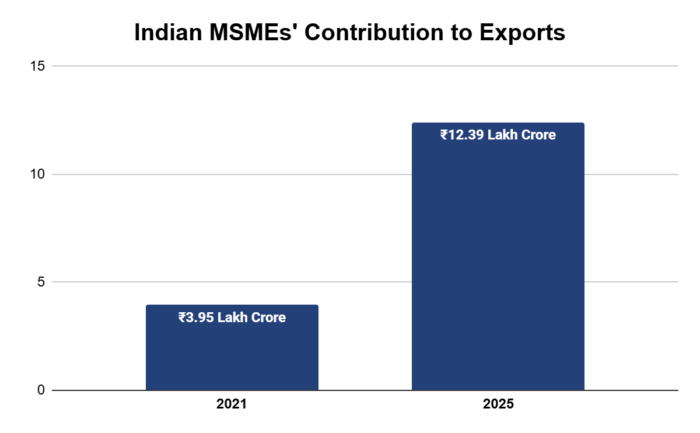
MSME exports have increased from ₹3.95 lakh crore in 2021 to ₹12.39 lakh crore in 20251, and the number of exporting MSMEs also rose from 52,849 to 1,73,350 in the same period. With small businesses contributing around 45.73% of the nation’s total exports, MSME-related products accounting for 48.55% of merchandise exports in 2024–252, the sector has secured a much stronger position in India’s export landscape.
While this progress highlights the rising importance of MSMEs in the country’s trade ecosystem, the focus in 2026 is not only on export growth but on export readiness, resilience, and execution.
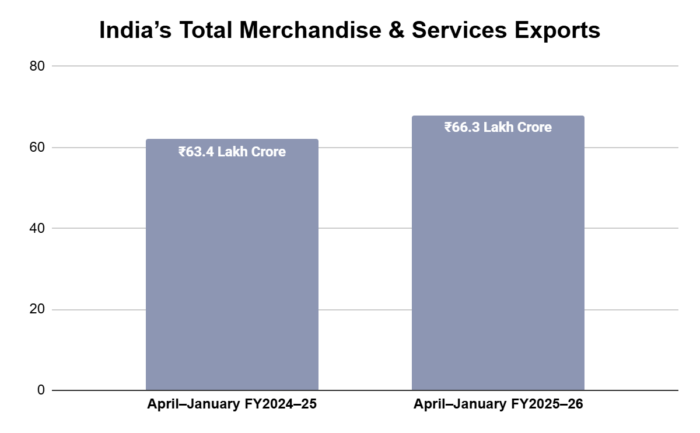
This blog article explores what the new export growth phase means operationally for MSMEs in 2026.
Export Environment Being Reshaped in 2026
India’s export environment is becoming more execution-focused. Easier trade processes, stronger export finance, better logistics and warehousing, digital systems, and disruption support are now shaping export growth. The Foreign Trade Policy 2023 continues to support this shift, while Export Promotion Mission 2 adds a sharper focus on implementation and business readiness.
That is what makes 2026 different. The issue is no longer only whether Indian products can find overseas buyers, but whether MSMEs are ready to handle larger orders, faster compliance, smoother logistics, and external uncertainty. The export story is now moving from opportunity to preparedness.
A key part of this shift is the Export Promotion Mission, backed by an outlay of ₹25,060 crore from FY2025–26 to FY2030–31. Through Niryat Protsahan and Niryat Disha, it aims to improve trade finance, credit support, logistics, warehousing, branding, and market readiness, making MSMEs more competitive in export markets.
Sectors Where MSMEs are Gaining Ground
India’s export growth has already been supported by strong sectoral foundations across agriculture, textiles, tea, coffee, and manufacturing. These sectors helped build the earlier momentum by drawing on India’s regional strengths, established clusters, and MSME participation across production and supply chains. In 2026, that base remains important, but the next phase of export growth is becoming more concentrated in sectors where policy support, global demand, and execution readiness are coming together more strongly. These include:
Engineering and Electronics
Among the strongest-performing sectors at present. Official trade data for February 2026 showed engineering goods exports growing by 12.90% year-on-year, while electronic goods exports rose by 10.37%4. This enhances the opportunities for MSMEs that supply components, fabricated parts, assemblies, packaging, tooling, industrial services, and other specialised inputs. The policy environment is also supporting this momentum. Initiatives such as the India Semiconductor Mission 2.0 and the Electronics Components Manufacturing Scheme aim to strengthen domestic manufacturing capacity and supply chains.
Textiles, Footwear, and Handicrafts
Labour-intensive sectors continue to remain important for MSME growth. Textiles, footwear, and handicrafts still offer strong opportunities because these sectors are closely linked to local clusters, regional skills, and employment. For instance, between April and July 2025, India’s cumulative textile exports were valued at approximately ₹1.07 lakh crore5. India’s footwear exports surged nearly 25% in FY25, with leather and non-leather shipments totalling ₹47,880 crore6, while the exports of handicrafts reached ₹33,122.79 crore in FY2024–257.
The export momentum is not only coming from existing cluster strengths, but also from policy measures aimed at making these sectors more competitive. In textiles, the government has been working on a more integrated policy approach, along with PM MITRA parks, to improve competitiveness, scale, and export strength. In handicrafts, support continues through infrastructure, technology, and digital market access for artisan-led businesses. Footwear also remains important, with MSMEs continuing to play a strong role across major production clusters, such as Tamil Nadu, Uttar Pradesh, Maharashtra, and Bengal, in the country.
Defence and Aerospace
Defence and aerospace have also emerged as stronger opportunities for MSMEs, with a manufacturing ecosystem aiming to achieve a national target of ₹50,000 crore in defence exports by 2029. For smaller manufacturers, this is not only about direct exports. It also creates room in machining, electronics, materials, fabrication, testing, maintenance support, and component supply linked to larger defence production chains.
Agri-Export and Marine Products
Agri-export and marine products are also expanding, with exports of meat, dairy, and poultry products rising by 22.66% in February 2026, while marine products rose from ₹30,213 crore in 2013‑14 to ₹62,408 crore in 2024‑25. For MSMEs, this can create opportunities in processing, cold-chain support, packaging, value-added food products, traceability systems, and other export-linked support services.
While the export growth is creating a larger opportunity for small businesses, it’s also bringing new operating demands.
Implications for MSMEs
For MSMEs, the benefit will depend not only on market access, but also on how well the business is prepared to manage risk, paperwork, logistics, and cash flow. Here’s what small businesses must focus on:
Risk Protection
Exporting is no longer only about reaching more countries or getting more buyer enquiries, but also about handling payment risk, geopolitical disruptions, shipping uncertainty, and route delays.
The government’s time-bound RELIEF Scheme, implemented through ECGC, has been introduced to address export risks linked to disruptions in the Gulf and West Asia maritime corridor. This shows that resilience is now becoming a regular part of export planning rather than something businesses think about only after a problem arises.
Logistics and Overseas Fulfilment Support
The same approach can be seen in the FLOW and LIFT initiatives under the mission framework. These measures are important because even a good product can lose competitiveness if freight costs are high or delivery timelines become uncertain.
FLOW supports overseas warehousing and fulfilment infrastructure, which can help exporters reduce shipping delays and improve delivery reliability in overseas markets. LIFT offers partial reimbursement of eligible freight costs for exporters in districts with lower export intensity. For MSMEs in Tier-2 and Tier-3 cities, these measures can be especially useful because distance, logistics costs, and delivery uncertainty often create added pressure.
Digital Trade Systems
When approvals, certificates, compliance updates, and market information move online, export processes become easier to manage. The government has highlighted platforms such as the 24×7 EIC interface, the Trade Intelligence and Analytics platform, the Common Digital Platform for Certificates of Origin, and the Trade e-Connect portal. Together, these systems are meant to reduce processing time, improve visibility, and make export transactions simpler and more efficient.
This matters even more for MSMEs in Tier-2 and Tier-3 cities. Many such businesses are already strong in production, but export process management can still be a weak area. Digital systems reduce dependence on scattered offline follow-ups and help smaller businesses handle documentation and compliance with greater confidence.
Working Capital
Working capital is another major factor in export growth. A business may receive a larger export order and still face difficulty in completing it if money is tied up in inventory, raw materials, production, or delayed buyer payments. In 2026, this challenge becomes sharper because larger orders, longer transit periods, and market uncertainty can all increase pressure on cash flow. This makes working capital central to export growth, especially for MSMEs that do not have large internal reserves. The policy direction also reflects this through its focus on affordable trade finance, credit support, and liquidity.
The MSMEs that benefit most from export growth in 2026 are likely to be the ones that prepare in advance.
Steps for MSMEs to Prepare for Export Growth
Export readiness starts much before shipment and depends on how well the business is organised internally.
1. Order Readiness
Businesses need to be ready with production capacity, and its associated tech upgrades to be able to fulfil orders are good speed. Along with production, even logistics need to be equally streamlined to ensure that products reach customers on time.
2. Internal Records and Process Discipline
Clear and clean view of purchase records, inventory visibility, vendor discipline, and tax documents play a critical role in ensuring that export compliance is upto the mark. These are no longer only back-end tasks. They directly affect how quickly a business can respond to demand and how confidently it can deal with buyers, certifying agencies, and lenders.
3. Financing Aligned to Order Cycles
Financing needs should be planned in a manner that they match the full export cycle, not only the production stage. Many MSMEs plan for manufacturing costs, but cash flow pressure often increases later through freight, compliance, packaging, testing, insurance, and delayed payments. Businesses that align financing with the actual export cycle are likely to be better prepared for scale.
4. Documentation, Digitisation and Compliance Readiness
As export systems become more digital and market requirements become more structured, MSMEs need to keep documents, certifications, testing records, shipment papers, and business data organised and accessible. Digitization plays an important role here, because it helps businesses manage records better, respond faster, and reduce delays across export processes. MSMEs that build strong documentation systems and maintain digital readiness as a regular business practice are likely to move more efficiently when export opportunities arise.
5. Planning for Volatility
Export growth in 2026 also requires businesses to prepare for uncertainty. Global trade continues to face external shocks, freight disruptions, and changes in demand. MSMEs that build buffers, diversify where possible, and protect shipments and receivables are more likely to sustain export gains over time. Planning only for growth is no longer enough. Planning for disruption is becoming equally important.
—
1Indian Brand Euity Foundation, Indian MSME Industry Analysis
2 Ministry of MSME, PIB, July 2025
3 Ministry of Commerce & Industry, India’s Total Exports Rise to USD 714.73 Billion in FY 2025–26 (Apr–Jan)
4 Department of Commerce, Government of India
5 Ministry of Textiles, PIB, August 2025
6. Wright Research: Overview of the Indian Footwear Sector 20257 PIB Headquarters, Handicrafts at the Heart of India’s Rural Economy, December 2025